Showing posts with label Fantasy. Show all posts

April 15, 2025

Dark Water Daughter, by H.M. Long

Fantasy.  Adventure.  Mystery.  Magic.  Pirates.  Swords.  Ethereal creatures.  Cold AF weather.  

This book has it all.


Enter a strange and magical world of ghistings (ghost-like creatures who inhabit mystical forests), stormsingers (women whose voices have the power to conjure and calm storms on the seas), and swashbucklers (come on, you know this one).  

From the dust jacket:

Mary Firth is a Stormsinger: a woman whose voice can still hurricanes and shatter armadas. Faced with servitude to pirate lord Silvanus Lirr, Mary offers her skills to his arch-rival in exchange for protection - and, more importantly, his help sending Lirr to a watery grave. But her new ally has a vendetta of his own, and Mary's dreams are dark and full of ghistings, spectral creatures who inhabit the ancient forests of her homeland and the figureheads of ships.

Y'all, this book is weird.  And I liked it.  Despite some major lulls in the story, author H.M. Long creates an exciting world to lay the foundations for the first novel of The Winter Sea series.  Some of her characters are likable; some of them are deplorable; some of them fall in between; some you think you'll like/hate, but end up hating/liking.  Set on a series of islands in a frigid sea, the fantasy world Long has created recalls images of the northernmost islands of Scotland, Scandinavia, and even a few locations within the Arctic Circle.  It was a great winter read by the fireplace.

As I mentioned, there were a few major lulls in the story.  I finished it in January (roughly three and a half months ago, at the time of this writing) so, while I cannot recall specific dull points in the novel, I do remember finding it rather long in some parts.  Overall, the book did seem to drag more than I personally would have preferred, though I know that some people really get into the world-building thing.  There were also a few annoying tropes (e.g. What is Mary going to do in this precarious situation?  What about THIS one?  Oh yeah?  How about NOW?) that I felt really took away from the story's progression, but it wasn't bad enough for me to put the book down.  It was mostly just an annoyance until the next good part.

So, will I continue the series?  Sure.  It's not a top priority, per se, but I could see myself completing it.  Ultimately, I feel that any subsequent novels in the series would be better audio books for me.  That way, I can at least be doing dishes while I enjoy a good story in my ear.

January 29, 2025

2024 Wrap-Up: A record breaking 7-in-1 post

 I got lazy toward the end of 2024.  Part of it was that I had surgery in October, then still did all the usual year-end things...and I was just tired.  Being laid up, however, provided ample time for reading -- so read I did.  Because I am barraging you with seven new titles, I decided to group them by category.  You know how I love categories.

CHILDREN'S NOVELS

My daughter is always complaining about having "nothing to read" (false).  As a result, I have gone back into the deep recesses of my memory to dig up some of the books that I read and enjoyed around her age (give or take a couple of years).  Here are a couple that she read -and I re-read- in the final weeks of 2024.

Stepping on the Cracks, Mary Downing Hahn

I was fortunate as a child to have an older sister who was an avid reader.  This meant that she would often read books and then suggest the good ones to me, essentially weeding out the boring shit.  Stepping on the Cracks was one such "good book" that she recommended to me when we were kids.


The story is set stateside during WWII.  Two young girls -best friends Margaret and Elizabeth- both have older brothers fighting overseas, and know firsthand how war can affect a family.  Still, they are pre-teenage girls and war certainly doesn't occupy all of their thoughts.  In fact, the merciless sixth grade bully Gordy Smith and his cronies are more prevalent in their day-to-day lives.  In a scheme to exact revenge upon Gordy and his friends for their latest antics, Margaret and Elizabeth make a startling discovery that will change the way they think of their neighborhood as well as the world -and the war- around them.

Stepping on the Cracks is a simple but poignant coming-of-age story.  While most of us didn't live through WWII, we can relate to the youthful goings-on of the protagonists.  Re-reading this book as an adult was no less exciting, but certainly afforded me the opportunity to experience it through a different lens.  As an adult and a mom, I related to characters that I hadn't previously considered.  Well worth the re-read.

Cat Running, Zilpha Keatley Snyder

Another period-piece-lessons-learned novel that both my daughter and I enjoyed is Cat Running.  This story, set in California during the 1930s, features another sixth grade girl as the main protagonist.  Cat Kinsey is frustrated by her traditional parents -specifically her father- who will not allow her to "wear slacks" like the other girls at school.  It's not just the mandatory dresses that annoy Cat, but the fact that she is a very talented runner and wants so badly to defend her title in the school's annual running/track competition...but being unable to dress in a way that is conducive to her goals (and being a tweenage girl with an out-of-touch parent) makes that extremely difficult and frustrating.


As a salve to her rage, Cat discovers a strange little hideout in the rocky cliffs beyond her family's property.  As she sets up shop in her new secret place, she discovers that she is not the only one who frequents it...and a strange new friendship develops that might just change her life.  Fun, informative, and thought-provoking, Cat Running is a great story for the junior reader in your life.

MURDER MYSTERIES (A.K.A. "HOT DOG BOOKS")

Y'all, I'd be remiss if I didn't have at least one (or three) murder mysteries in my 7-in-1 post.  They need no introduction, so I'll just get started...

Miss Morton and the Deadly Inheritance, Catherine Lloyd

Devotees (ha!) will recall a series that I began in 2023: the Miss Morton books by Catherine Lloyd.  Deadly Inheritance is the third book in this series and follows the same format as the first two:  Miss Morton and the English House Party Murder and Miss Morton and the Spirits of the Underworld.  Honestly, I don't feel like it merits a full review because it's just the same formula.  It's predictable, fun, and I don't care what you say, I'm going to keep reading them.


Death Comes to the Village, Catherine Lloyd

Prior to the Miss Morton books, Catherine Lloyd penned a series of Death Comes to ____ books, featuring a practical, similarly minded leading lady:  Lucy Harrington.  Once again, "devotees" (double ha!) will recall that I began this series back in 2023, but unknowingly started with #3 of an eight book series.  (Previously read: #3 Death Comes to Kurland Hall and #4 Death Comes to the Fair.)  Since I've been doing a lot of hot dog reading in my convalescence (gearing up for another surgery next week...), I figured I ought to go back and start this series from the beginning with #1 Death Comes to the Village, and work my way through this series (skipping #3 and #4).  So far, same song and dance: fun, mindless, love mine with mustard and relish.


Vera Wong's Unsolicited Advice for Murderers, by Jesse Q. Sutanto

In a surprising turn of events, I left England's murdery countryside and landed in present day San Fran's Chinatown.  Stereotypical tiger mom Vera Wong runs a little tea house where nothing exciting happens...until one day, a man's body is discovered right in the middle of her shop.  Of course, the police department isn't up to snuff, so Vera must take over the investigation herself so that things will be done correctly.  As she continues her detective work, Vera finds herself cozying up to a laundry list of suspects, all people who knew the deceased.  What she doesn't expect is to find herself caring deeply for these people, their lives, and their well-being.


My husband and I listened to this book together (vs reading it in print) and, let me just say, we fully enjoyed it.  It was funny, suspenseful, and heartwarming -- a rare combination.  I would recommend Vera Wong to anyone who might enjoy a fun escape, particularly accompanied by a good cup of Chinese tea.  (Bonus:  Vera will be back in another novel set to release in March!)

MISCELLANEOUS (FANTASY + SHORT STORY)

The final two entries for this post fall into two separate categories.

Taliesin, by Stephen Lawhead

Last year, I listened to a Stephen Lawhead book In the Hall of the Dragon KingIt was OK, kinda contrived, not my favorite.  Still, I mentioned in that review how I wanted to try another couple of Lawhead's books/series, so I did.  Taliesin is the first in The Pendragon Cycle, a series featuring a cast of Arthurian characters.  


An epic build up to what is certain to be quite the universe, Taliesin spans perhaps an entire continent between Atlantis (a kingdom in its twilight) and a post-Roman Celtic world (that sounds a lot like Wales) that is on the rise.  Worlds collide, characters meet, years pass, and loved ones are lost or changed.  It's all the things that a fantasy prequel promise to be.  Nevertheless, I did find a lot of contrived action similar to that which I detailed in my review of Dragon King.  There were elements that were simply too forced for my liking, as well as a lot of "by the way" information crowded into the final chapters.  While it wasn't a bad read, per se, I will not be likely to pick up the second book in the series.  

The Turbulence Expert (from You Like It Darker), by Stephen King

My husband is a long time fan of Stephen King.  In fact, I believe he has read everything the guy has written.  (If not, it's pretty damn close.)  One of King's latest publications is a series of short stories in the book You Like It Darker.  


My husband hates flying; he hates heights.  As such, he related a great deal to the main character in the short story The Turbulence Expert from this collection and prompted me to read it, since I know these details about him.  Without divulging too much, the main character in the story shares my husband's fears, making him a perfect fit for a (fictional???) job as a "turbulence expert".  And that is all I'll say.  A fun and eerie read that will take you only a matter of minutes.


And that concludes 2024!  I've already made considerable progress in 2025 and am about to wrap my fourth book.  I will probably be back to review throughout the year, but I make no promises at this time!

HAPPY READING!!!


October 28, 2024

Historical/Gothic Fiction with Hester Fox

 In previous posts, I have reviewed books by the contemporary author Hester Fox.  Fox tends to gravitate towards gothic fiction, often set in the 19th century.  For previous posts on her works, click the links below:

The Witch of Willow Hall (2018)

The Widow of Pale Harbor (2019)

A Lullaby for Witches (2022)

The Last Heir to Blackwood Library (2023)

Over the past month or so, I read the remaining two (current) publications by Hester Fox.  To be honest, I really didn't love either one.

The Orphan of Cemetery Hill (2020)


Y'all, this book was B-A-D.  The characters were dull, the plot was preposterous, and the denouement was non-existent.  The main character is a young woman by the name of Tabitha Cooke.  Tabitha can commune with the dead, but this fact must remain a secret so that people don't take advantage of her.  She is impoverished and an orphan, separated from her older sister -who can see the future- during her childhood.  When Tabitha's friend's fiancée is murdered, he is suspect #1.  Of course, he didn't kill his lovely bride-to-be and Tabitha knows this, since she talked to her ghost.

And it just goes downhill from here.  But I still read it.  Shame on me. 

The Book of Thorns (2024)


Hester Fox's most recent publication is tepid, at best.  Two sisters were separated so early in childhood that neither of them actually recalls having a sister.  However, a bond they share -a gift their mother also had- is their ability to commune through and with flowers.  During the Napoleonic wars, older sister Cornelia is working with the French army as a healer.  Younger sister Lijsbeth is mostly mute, and works as a housemaid for a wealthy family in Belgium.  On opposing sides of a war, the sisters reconnect with each other, learn about their past, and are able to piece together their futures.  In Hester Fox fashion, it is contrived and (mostly) predictable.  I also found it annoying how hard she clearly worked to get a f/f/m love triangle worked into the plot.  It felt forced and did not add one iota of excitement to the story.  While I won't say it was her worst book, I'd rate it slightly below average.

If you asked me today to rank these books, I would probably do so as follows:

  1. The Last Heir to Blackwood Library
  2. The Widow of Pale Harbor and/or The Witch of Willow Hall **
    **Caveat being the first scene of the book where a cat is hurt.  Hated that.
  3. A Lullaby for Witches and/or The Book of Thorns
  4. ----
  5. ----
  6. ----
  7. ----
  8. ----
  9. ----
  10. ----
  11. The Orphan of Cemetery Hill
Hester Fox will be releasing another book in 2025.  I'm eager to read it and rank it here for you!

Unfinished Business: Books I did NOT complete

 It isn't often that I will start to read a book and make the decision not to complete it.  Even if it's not great writing or the characters suck, I'm too stubborn to put it aside.

Except that I did just this three times in the past few months:

A Play of Piety, by Margaret Frazer

After reading the first few chapters of this book, I was just. so. bored.  I wanted to like it.  I tried to like it.  I just couldn't get into it.  Furthermore, I was not remotely invested in the characters and, looking ahead, I happened upon a scene where a dog is killed.  It's a merciful death, but still sad.  Pass.


Jacob Have I Loved, by Katherine Paterson

This book started off strong.  Paterson's narration is both pleasing and easy to read.  I enjoyed her exposition through the pathetic first person narrator about things from seasons to food to jealousy.  However, about halfway through the book, one of the worst scenes I've encountered in literature presented itself.  This scene is graphic, inhumane, and abhorrent.  I found myself wishing I could strangle Paterson myself for putting these pictures in my head and now, without hesitation, I can say that I hate both her and her work.  And her main character -the one with whom readers are meant to empathize- is a spineless, brainless, piece of excrement.  No wonder everyone loves her sister and simply tolerates her.  She sucks.  HARD PASS.

Tales of King Arthur, by Sir Thomas Malory,
Edited and abridged with an introduction by Michael Senior


I've read a number of Arthurian legends.  I've known many of the stories for years and years but it wasn't until I was in a French literature class that I actually read my first original work.  We read Le Chevalier au Lion (The Knight with the Lion) by Chretien de Troyes.  On each two-page spread of the text were the old, original French (left page) and the updated, modern French (right page).  With a sort of dual-language book like this, we could not only read the story, but compare and contrast the current words with the original.  It was one of my first novels in French and that fact, coupled with the type of lyrical writing even of the modern translation, made reading the story of Sir Yvain as a knight errant rather cumbersome.  Nevertheless, we carried on.  I had also read -in both English and French- the story of Tristan et Yseut (Tristan and Isolde), along with numerous other adaptations of different stories of Arthur and his knights.

While I do love the adventures and the kickass stories themselves, after awhile, they start to drone on.  Malory is very very wordy, and his characters are quite flat.  For instance, Arthur is always perceived as a hero...even though he casts a ship full of babies out to sea, leaving them to die in case one of them is his repudiated son Mordred.  Sorry, Art, but that's not a redeemable act.  Merlin coerces a teenage girl into doing...things with him and, when the bill finally comes due (read: she enacts her own justice), she is the one painted as a villain while poor Merlin is victimized.  Barf.  Morgan le Fay is, as always, portrayed as a toxic malevolent when, let's get real, it was Arthur's birth father (Uther Pendragon) who killed her father, forced her mother to marry him, and then was a general asshole.  Maybe Morgan is nasty, but she's got her reasons.  All in all, the more I read of King Arthur, the more I tend to empathize/sympathize with the alleged bad guys.  You might say that the writings are "of their time", but I am also of my time.

This edition of Sir Thomas Malory's accounts is a great start for readers new to the Arthurian legends.  It's a challenging read, but simplified in order to appeal to a modern reader without having to do too much research or investigating.  In fact, that is exactly what Michael Senior (editor) intended: to create a loyal rendition of Malory's work that is also pleasing to read.  I would say he accomplished his mission; I just simply could not read the entire thing cover to cover without breaks to read other stuff.

Three books - each unfinished.  I have to remind myself when I pick up a book that I am under no obligation to finish it.  Sometimes, you just don't, and that's OK.  I've moved on since then, even finishing a couple of other books in the meantime.  Stay tuned for more reports on books that I have completed.

October 1, 2024

Witches, Witches, Everywhere! (A NEW 4-in-1 post)

Four books.  I'm writing about four books.  This is a new multiple book post record!  But I felt that these books were appropriate to put together as they all revolve around a similar theme.  Since we are approaching Halloween, what better time to talk about...


...witches!!!

Three of these four books are by the author Hester Fox, whom I mentioned in a previous post that included her 2023 novel The Last Heir to Blackwood LibraryAfter reading several more of her works, I can see that Ms. Fox most definitely follows a formula and, so far, always in the genre of gothic historical fiction.  While her stories are not what I would consider particularly highbrow, nor do they stick with you after the final page, they are certainly entertaining.  And sometimes, that's just what you need.  (Hot dog books, am I right?) If you go into one of her novels with this mindset, you might find yourself swept up in a dark, broody past, typically set in mid-19th century New England (Blackwood Library being the one exception among those that I've read thus far).

Anyway, the first of these witchy novels that I'd like to talk about today is Hester Fox's debut book:

The Witch of Willow Hall

After a series of damning rumors destroy the reputation of the Montrose family, sisters Catherine, Lydia, and Emeline -along with their parents- find themselves moving from Boston to the small town of New Oldbury, Massachussetts.  Set in the early 1820s, the Salem witch trials are a thing of the past...but not forgotten.  As Lydia (our main protagonist and first person narrator) begins to notice strange things around the country estate, things take a supernatural turn.  Lydia eventually discovers her family's dark secrets and scandals but, most of all, she learns that certain traits -and abilities- run in the family.


I hated how this book opened.  Like, HATED IT and almost refused to read it any further than the first few pages.  People who know me understand one thing very well:  I do not abide animal cruelty.  In any form.  I don't tolerate it in books, TV, movies, anything.  The animal can end up fine but, if you're a storyteller and you put an animal in distress, then I'm simply no longer interested in anything you have to say as a writer or as a human being.  As such, you can imagine my disappointment when the story opened by describing -in moderate detail- an event taking place where my favorite animal was killed.  While I understand Hester Fox's use of this event to illustrate the goodness in the main character (who absolutely loses her shit at this loss of a beloved pet), I do not appreciate it.  ONE HUNDRED THUMBS DOWN FOR THIS, MS. FOX!

In a very uncharacteristic act, I continued reading.  I don't know why I did, but I did so with caution.  I knew that if one more animal got hurt, I'd be done.  (That was it, by the way.)  However, the book was filled with a number of other triggers that, for people like me, can be quite problematic.  [At the risk of spoilers, readers beware:  A baby dies (possible miscarriage).  A child dies (actually, two kids die).  There are some mildly graphic mentions of hangings and house fires.  There is consensual incest.]

Ew.  Come to think of it, why did I like this book?

OK, so some weird and gross shit happens.  It was the 1800s, man!  People were weird AF!  But there was a lot of action in the book that did not fall under any of these categories and was not gross.  I just felt compelled to share some common triggers with y'all.

"It was the 80s, man!  I told you, the 80s was a wild place."

Personally, I love the theme of witchcraft.  When I say witchcraft, I'm not referring to the dark arts or sinister practices, rather to the idea of women asserting power when and where they can.  Imagine growing up in a world where you had no voice, your only purpose was to make a good match (hoping he wasn't an asshole), serve your husband, procreate, and keep it tight.  Your entire existence was subservient, reading novels was frowned upon and led to mental distraction, your appearance indicated your level of sanity (looking disheveled being the equivalent of insanity), and you were so tightly buttoned up -both literally and figuratively- that any misspoken word could destroy your reputation.  All this while your bones are being contorted in tiny, pointed shoes and your lung capacity diminished in disfiguring corsets.  It's no wonder we all got the vapors!

But there is something about witchcraft that reasserts a level of power.  Think about the symbols of witchcraft:  an understanding of nature and herbs (in a cauldron?) to heal and soothe, a broom to maintain cleanliness of a space, a cat to chase the mice away (still thinking hygiene, not to mention companionship), a connection to other women and their shared wisdom.  That's witchcraft.

Ultimately, it is this sort of witchcraft that is wielded in this book.  Generations of women, passing down their compassion, wisdom, and understanding to their daughters, granddaughters, and beyond.  Isn't that a lovely thought?

But yeah.  Some spooky and gross shit happens too.

A Lullaby for Witches

I'm just going to include the description for this book from it's Amazon page because I could do no better:

"Two women. A history of witchcraft. And a deep-rooted female power that sings across the centuries.

Once there was a young woman from a well-to-do New England family who never quite fit with the drawing rooms and parlors of her kin.  Called instead to the tangled woods and wild cliffs surrounding her family’s estate, Margaret Harlowe grew both stranger and more beautiful as she cultivated her uncanny power. Soon, whispers of “witch” dogged her footsteps, and Margaret’s power began to wind itself with the tendrils of something darker.

One hundred and fifty years later, Augusta Podos takes a dream job at Harlowe House, the historic home of a wealthy New England family that has been turned into a small museum in Tynemouth, Massachusetts. When Augusta stumbles across an oblique reference to a daughter of the Harlowes who has nearly been expunged from the historical record, the mystery is too intriguing to ignore.

But as she digs deeper, something sinister unfurls from its sleep, a dark power that binds one woman to the other across lines of blood and time. If Augusta can’t resist its allure, everything she knows and loves—including her very life—could be lost forever."


Unlike the witches in The Witch of Willow Hall, we encounter a darker force in the sequel-ish novel A Lullaby for Witches (also by Hester Fox).  Of the books I've read by this author (to date), this one is my least favorite.  The concept was intriguing, but the characters were bleh.  Ultimately, the plot felt contrived and the conclusion was forced.  I did like the main characters' connections to the Montrose family from The Witch of Willow Hall, but it fell short in most every other way.  In fact, it was so unmemorable that I'm done talking about it.

The Widow of Pale Harbor

In yet another novel by Hester Fox, we encounter the idea of witchcraft, but in a non-magic sort of way.  None of the characters in this book possess any actual powers, although rumors swirl in accusation of such wickedness.  

Set in the sleepy, idyllic town of Pale Harbor, Maine, we meet the newly bereaved Gabriel Stone, a widower intent on honoring his late wife's wishes of spreading the transcendentalist movement.  While Gabriel doesn't particularly believe in transcendentalism himself, his wife was passionate about it and, feeling a sense of guilt at her death (childbirth), he feels compelled to do something for her.  It's weird and far-reaching, but people do weird things for grief, I guess.

Meanwhile, the spooky, witchy widow Sophronia Carver ("She has a tail!") is living alone up at Castle Carver (not a castle, just a bigass house) with only three discreet servants to help her.  The entire town suspects Sophronia of having killed her late husband, a well-respected businessman and magazine editor, whose cosmopolitan appeal charmed the residents of the small town.


Remember how I said Hester Fox had a formula?  It applies here, too.  But please also remember what I said about that:  "While her stories are not what I would consider particularly highbrow, nor do they stick with you after the final page, they are certainly entertaining. [...]  If you go into one of her novels with this mindset, you might find yourself swept up in a dark, broody past, typically set in mid-19th century New England" (source: me).

Just like the premise for the character of Gabriel Stone, the entirety of this book is far-reaching from a critical standpoint.  But, these unbelievable prompts are what propel the plot (alliteration!) and allow for readers to be entertained.

Finally, in a deviation from Hester Fox, I have one more book about witches.

The Girl and the Witch's Garden

This final book centering on witches is nothing like the previous three.  In fact, this is a children's novel by author Erin Bowman.


When young Piper Peavey's father is diagnosed with cancer, she is sent to live with her estranged  mother and distant grandmother at the mysterious Mallory Estate.  Upon arriving, Piper learns that her mother has taken in a number of other children -all with magical abilities- while neglecting her own daughter.  Frustrated at her mother's apparent enthusiasm for her foster kids, Piper becomes hurt, jealous, and determined to figure out what is behind the strange happenings at Mallory Estate.

I was honestly drawn to this book by the cover art.  Isn't it charming?!?!?!?!  I love the illustration (especially the cat) and thought that my own daughter might enjoy the book, so I checked it out from our local library.  At the end of the story, she and I agreed: although it wasn't a particularly memorable read, it was (like those of Hester Fox) entertaining for the duration.  It's about the ride, right?

Clearly drawing from more classic children's literature (think: Harry Potter, The Secret Garden, etc.), The Girl and the Witch's Garden is a charming read, even for adults.  Themes of loss, grief, friendship, belonging, and family are all included in this story of the main character and her discoveries.  (Of note:  There are some potential triggers in this book as well including, but not limited to abuse, neglect, loss of a parent.)


Four different books, mostly enjoyable, all featuring something pertaining to witches.  Happy reading and HAPPY HALLOWEEN!


September 16, 2024

Elements of Cadence, a two part series by Rebecca Ross

 You guys know me by now, I think.  You know that I like fairytales, multi-faceted characters, elements of mystery, and -yes, I must confess- a drop of romance.  

Several months ago, one of my students paid me a great compliment: she recommended a book to me.  Yes, I know, anyone can recommend a book BUT, she recommended a book to me because she knows what I like and made her suggestion based on that.  What better compliment than to show that you know a person well enough than to offer them an adventure that is likely to please?

This student suggested that I read A River Enchanted, by Rebecca Ross.  At the time, I was not aware that this was the first in a duology.  It appears that both books were published in 2022, so I imagine they could be read like one great big mega book.  I listened to A River Enchanted on the Libby app and, upon discovering that it was the first of two, I immediately reserved the sequel, A Fire Endless.  So, some time lapsed between the two, but not enough for me to forget important plot elements.


Set on the fictitious island of Cadence, one can easily imagine this place as a far northern, remote location of Scotland.  In fact, the reader is Scottish (or at least reads with a Scottish accent, even during the book's credits), "the mainland" is often referenced, and the characters' plaids and kilts are frequently described.  "The Folk" (fairies/spirits) play huge roles throughout both of these novels, so they are -at the very least- inspired by Celtic legends and folktales.  And I love that.

We begin the story with Jack, a fatherless child of Cadence, whose mother had sent him to the mainland ten years prior to go to school and learn to become a bard.  In this time and place, a bard is a very prestigious position, reserved only for those who are very gifted in the art of song and storytelling.  Jack is summoned back home to Cadence -much to his chagrin- when he is around 20 years old.  Upon his return, we meet his family and the three other characters who will serve as the main ensemble for the rest of the duology: Adaira (heiress to the Tamarlaine clan lairdship), Torin (head guardsman, cousin of Adaira), and Sidra (talented healer, wife of Torin).  These four characters -Jack, Adaira, Torin, and Sidra- will continue to drive the plot for both books.  (Of no particular note: Sidra is my personal favorite.)

We also learn that the Isle of Cadence is split between two warring clans: the Tamarlaines in the East (clan to which our four protagonists belong) and the Breccans in the West.  The East has been blessed with bounty, light, and music, but they are often invaded by the West for their crops, livestock, and goods.  The West is a cold, desolate place where the people are hardened and desperate enough to invade the enemy territory in the East.  Still, the West has been gifted access to certain types of magic with little cost, rendering them all the more lethal to the East.

When Jack is summoned back to the East from the mainland, he soon learns the reason why.  Young Tamarlaine girls have begun disappearing and the heiress Adaira believes the spirits of the isle are behind it.  If nothing else, they might know why and where the girls are being taken.  But, in order to summon the spirits, a bard is required.  As the Tamarlaine clan has not had a bard since the death of Adaira's mother, the heiress is compelled to ask Jack to come back and sing for the spirits so that she can ask them for wisdom regarding the disappearance of the girls.  Reluctantly, Jack agrees to help.

Mysteries are solved.  Dark secrets are revealed.  Adventures are had.  It's a great fantasy read that incorporates so many of the things that I love about a good book and, as such, I would highly recommend the Elements of Cadence duology to anyone who is looking for a good escape.


August 20, 2024

Summer of the Sea Serpent, by Mary Pope Osborne

Clearly, I love to read.  Chances are, if you're reading this, you do too...or else you wouldn't be here, as I tend to get rather wordy.  The affinity that I feel for characters in books often surpasses that which I feel for people in reality.  I prefer to live in a fictional world with my "friends" than in reality about 90% of the time.  

A love for reading -be it for the same reasons as mine or not- is something that I hope to pass on to my kids.  A local library can take you places your bank account cannot.  Sure, it would always be better to travel to the Andes than to read about them, but we can't all afford that.  Yes, it's preferable to see the Louvre in person but, until you've saved up the thousands of dollars necessary to visit Paris, it ain't gonna happen.  Books give us a passport to the world - the one we actually inhabit, but also to the one of our imaginations.  And that is something that money can't buy.

Every once in a while, my kids will read a book that they later recommend to me.  So far, these suggestions have been easy reads, as Frick n Frack are still growing and developing as readers themselves.  But a book seeming "basic" is not grounds for dismissal.  Some of the greatest pieces of literature are the simplest ones.  More importantly, though, I always want to keep those lines of communication open with my kids, particularly when it comes to them sharing their lives, passions, and interests with me.  That is a gift.

Since they were wee sprouts, their grandma (my mom) has been reading the Magic Tree House series to my kids.  As they got older, they branched out further to read them independently.  It was one of these books that my son recommended that I read.  


An offshoot of the original Magic Tree House series, the Merlin Missions still feature the brother-sister main characters Jack and Annie.  Fans of Arthurian legend will appreciate the nods to Camelot with characters like Merlin and Morgan popping up here and there throughout the various series, all penned by Mary Pope Osborne.  Full of adventure, action, and riddles, young readers enjoy the ride alongside Jack, Annie, and their friends.  There is very little exposition, which allows the plot to move along at a quick clip.  For those of us used to reading classic literature, this is a welcome reprieve.  Adults can expect to read one of these books in maybe an hour(ish).  

While it may be easy to do so, I would caution against dismissing these books as easy.  At first glance, they certainly seem to be just that (remember the target audience!), but I would argue that they are quite thoughtfully crafted.  They introduce young readers to a broad array of highbrow literary themes, characters, history, and cultures.  To do so in a succinct way that appeals to children is nothing short of genius.  Hats off to Mary Pope Osborne for scratching the surface in ways that introduce kids to these concepts, inviting them to dive deeper into the topics that interest them.

When my son asked me to read Summer of the Sea Serpent after he had finished it, I was touched.  Not only was he asking me to share an experience with him, it gave us something to discuss, a topic that interested him.  I am honored that he wanted to share that with me and look forward to all future recommendations from my kids...even if they are not books that I would likely pick up on my own.


August 9, 2024

Guys, I have a problem: more (murder) mysteries in a 3-for-1 post

I said it in the title and I'll say it again:  Guys, I have a problem.  I can't stop reading murder mysteries set in Great Britain.

These novels are all so contrived.  Most often, I guess the ending (at least in some capacity) before arriving at it, but I just enjoy the ride.  The character development is, if not profound, kind of fun; I like a puzzle and I like suspense.  But why are they always British?  I like tea and rain, but their food sucks and the period piece social hierarchies annoy the hell out of me.  I spent the entirety of the latest Downton Abbey movie hoping that we'd see the 1929 stock market crash so that I could watch the entitled Crawleys struggle to work and live like the rest of us.  (What can I say?  As an American, I'm born and bred to be informal and egalitarian.  I HAVE NO 'BETTERS'.)  So why do I keep gravitating to this very specific genre?

Today, I figured it out.

I'm not unique in my love of mystery novels.  There's a reason the genre is so prolific: people love it.  I'm also not unique in my interest in history and proclivity for historical fiction.  This Brit Lit often combines the two: mystery and history.  But, above all, the British mysteries towards which I gravitate are not violent.  Yes, there is violence in them (they are murder mysteries, after all), but it is never so graphic as to be difficult or gratuitous.  None of the authors whose works I've been reading go into gory details.  To add, animals rarely (if ever?) get hurt, which is a feature that I cannot/do not abide.  These are books that are easy to get lost in.  They are suspenseful without being scary.  They are safe (for the reader...not for the characters!), fun, and lend a sense of excitement to an otherwise mundane or routine day/week/month/whatever.

This past year, I have read a lot of mystery novels that I have reviewed here.  And, shameful though it may be, I don't intend to stop.  It's not the worst vice I have.  So, without further ado, here are the three most recent titles I have enjoyed:

The Hummingbird Dagger, by Cindy Anstey

In 1833, a young woman is found unconscious after a carriage accident outside a small village.  When she awakens, she has no memory of who she is or how she arrived at Hardwick Manor with the Ellerby family, where she now finds herself.  As she recovers, she tries to piece together her mysterious past and how it pertains to some of the strange happenings she and her new friends observe about the village.


As a Young Adult novel (I don't judge), The Hummingbird Dagger keeps a steady pace.  The characters may be flat and predictable, but that is precisely what keeps things moving in books like these.  It doesn't drag or spend too much time pontificating on useless details.  Easy to read and hard to put down, I'd recommend it as a "hot dog" book.

Miss Morton and the Spirits of the Underworld, by Catherine Lloyd

Last summer, while on vacation, I read the book Miss Morton and the English House Party Murder by Catherine Lloyd.  This summer, I picked up the second book in this series (by one of my favorite hot dog writers!) and enjoyed the hell out of it.  Much like every other book of this genre, Miss Morton and the Spirits of the Underworld is full of smoke and mirrors...and tropes.


Miss Caroline Morton is a fallen-from-grace blue blood, because her father made some bad decisions before croaking.  The former Lady Caroline has transformed into plain ol' Miss Morton, companion to the rich-by-honest-means (read: made money because of working) Mrs. Frogerton.  Bonus: former Lady Caroline/Miss Morton is also able to advise Mrs. Frogerton's daughter Dorothy on the upper crust meat marriage market.  But don't worry, Miss Morton isn't old and washed up yet.  This ol' bird's still in her twenties and keepin' it tight.

When Mrs. Frogerton drags Miss Morton to a seance, they have a terrific -albeit weird- time.  It's basically the equivalent to today's haunted house scene, but less bloody and more ghosty.  Apparently, in Regency England, people were very easy to dupe because they didn't have internet.  But when the spiritualist, Madam Lavinia, turns up dead, things get weird and it's up to our protagonists to solve the case...much to the dismay of the real police.

Just like its predecessor, Spirits of the Underworld is a fun, easy ride.  At barely 300 pages, it's a relaxing read that doesn't demand much from the reader at all.  And great news to me (although probably not to Miss Morton), there is another murder mystery that will rock her world later this month when Miss Morton and the Deadly Inheritance hits shelves on August 20!

The Last Heir to Blackwood Library, by Hester Fox

This last one isn't quite a murder mystery.  In fact, there is no murder -mysterious or otherwise- to solve!  Set in England just after the first World War, young Ivy Radcliffe suddenly inherits Blackwood Abbey in the Yorkshire moors.  Apart from her best friend and roommate, Ivy is alone in the world after losing her entire family to war and illness.  She is struggling to make ends meet in London and, upon the death of a distant and unknown relative, she is now proprietor of a great estate up north.  But when Ivy arrives at Blackwood Abbey, things become worrisome: gaps begin to appear in her memory, strange things happen in town, and rumors run rampant.  The staff are cold and distant.  Even the abbey itself seems to be haunted, leaving Ivy with no one and nowhere to turn for relief.  It is only when Ivy discovers the abbey's secret and mysterious library that she begins to make a home for herself...but things are never as simple as they seem.


A slight deviation from the classic murder mystery genre, I lumped this one in because it embodies the same sort of mysterious spirit that draws me to these books.  Written by New England author Hester Fox, The Last Heir to Blackwood Library has a flavor to it that reminds me a great deal of Rebecca, by Daphne du Maurier.  Both are Gothic novels featuring a young, naive heroine who must find her place in newfound status; both have dark undertones coming from the environs, atmosphere, staff, and the physical house itself that they are now tasked with running.  It's weird.  It's different.  I liked it.


I will try to branch out some more with a few non-mystery novels.  I have several other genres in my present line-up, many that I've already read and are just awaiting written reviews!  But I never make promises unless I know that I can keep them. ;)

May 8, 2024

In the Hall of the Dragon King, by Stephen R. Lawhead

I'm a big nerd.

I know this must be coming as quite a shock to you, but I've never been cool.  Not once in my life.  Just ask my kids.  

This nerditude extends to literary genres, too.  I know I've told you that I'm a sucker for period piece murder mysteries, but I also have a heart for fantasy fiction as well.  (And, apparently, accidental alliteration.)  It likely stems from a childhood love of fairy tales and mythology that grew to include wizarding worlds and Middle Earth in my adolescence.  But it has been a long time since I've read a book with that sort of magic.

A friend of ours recently recommended the author Stephen R. Lawhead for some of his historical fiction -- another favorite genre.  I'd never heard of Lawhead, but the guy sure is prolific!  Of particular interest (to me) are his Pendragon Cycle (love a good Arthurian legend!), Eirlandia (I have a weakness for the Emerald Isle), and Byzantium. (Spanning Ireland to modern-day Turkey, this epic covers lots of points and places of personal interest: I'm 50% Middle Eastern, with the remaining 50% being mostly split between ancient Celtic and Norse lands.)

After learning more about this author, I figured I'd give one of his works a shot, and decided to do so in audio format.  Unfortunately, the selection was limited; none of the series/novels listed above were available.  In fact, there were only a couple of options and, of those, I would have had to start with the second book in a series.  There was only one possibility to start at the beginning of a series, and that one was a fantasy series written for young adults:  In the Hall of the Dragon King, the first book of The Dragon King trilogy.


No matter.  I'm not above YA fiction.  Sometimes, I think it's even better, especially when it comes to fantasy fiction.  With YA novels, there is a tendency to focus more on the story and less on, say, 75 pages describing a type of hobbit tobacco.  (I'm looking at you, Tolkien, you longwinded bore.)

With the excitement of starting a new novel -one of a beloved genre that I hadn't touched in years!- I dove right in.  And it didn't take long to get right into the action.  But there was a bit of a surprise that, while not bad per se, kinda took me out of it.

Fully recognizing the irony of my own wordiness (I know, Tolkien!  Quit judging me!), I'm going to deviate a bit from this review to tell you a little story.  Travel back in time with me to the early 2000s... [Insert chimes, wavy lines, blurry camera]

I was in college. A group of guy friends invited a group of girl friends that I was hanging out with at the time over to their house to watch Braveheart.  (The movie selection tells you right away that this particular group of guys was not in the habit of hanging out with girls, but we accepted.)  Up until this point, I had never actually seen Braveheart in its entirety, only catching scenes and snippets here and there.  Ever the nerd, I was actually pumped about watching this movie.  We dimmed the lights, crunched on popcorn, and watched William Wallace defend Scotland and fall in love.  But then that monstrous king and his goons came and raided the village.  They exacted their revenge on WW by killing his secret wife since she had not made herself available for Prima Nocta, and also because they were assholes.  WHAT?!?!?!?!  HOW COULD THIS BE?  WHAT WILL MEL GIBSON DO ABOUT IT BECAUSE WE ALL KNOW HE IS NOT THE TYPE TO TAKE THIS LYING DOWN AND WHAT THE HELL, JOSH, WHY ARE YOU STOPPING THE MOVIE?!?!?!?!?!?!?!

Actual footage of me when Josh stopped the movie. 
(I've changed my hair and shaved my beard since college.)

Just as our protagonist was being thrust into the hardship that would lead him to greatness, Josh, the guy who had set up our little movie party, stopped the movie.  Why?  Well, he wanted to know if we, like William Wallace, had ever faced hardship in our lives, and how God surprised us with His wisdom and blessings.

Well, Josh, I was a (roughly) 19-year-old girl.  So um, no.  Not really.  I couldn't particularly relate to William Wallace in this story.  To be honest, my husband (whom I wouldn't even meet for another few years) never had to face some monarchical prick who wanted to deflower him on our wedding night, under threat of death.  Also, as I'm not trying to save 13th century Scotland, I cannot particularly relate to my hometown being raided by feudal thugs.  But what YOU'RE doing right now seems a little despotic.  So, I guess there's THAT...

We never finished Braveheart that night because Josh wanted to talk about God.  The whole thing was orchestrated as a secret, surprise Bible study, which would have been fine had it not been a sneak attack.  I went home, feeling played and disappointed that I'd have to walk to Blockbuster that night to rent the movie -on VHS or DVD, depending on which format was available- if I ever wanted to find out how Mel handled the death of his lovely Scottish bride.

Stephen R. Lawhead kinda pulled a Josh on me with In the Hall of the Dragon King.  I was expecting some thrilling fantasy ride (more on that in a minute), but he surprised me with semi-religious fiction.  To be clear: I do not mind allegorical writing inspired by faith or religion.  I just prefer to see it so skillfully done that it doesn't seem cheap.  Or even just not to be surprised by it.  My opinion is that it was rather forced in Dragon King; it caught me off guard and took me out of the story.  

Speaking of the story -the real reason we're here- it is clear whence Lawhead derives inspiration (apart from the Bible).  A coming-of-age novel in which a young protagonist embarks upon a heroic quest, it's a tale as old as time, which isn't necessarily a bad thing!  A narrative theme that is almost synonymous with the birth of storytelling itself, the hero's quest continues to be fan favorite.  Gilgamesh did it; Odysseus did it; Beowulf did it; Frodo did it; Bilbo did it; Luke Skywalker did it; the Pevensie kids did it; Aerin did it; Harry Crewe did it; Harry Potter did it; Eragon did it; Roland Deschain did it; Percy Jackson did it; Dorothy did it; Indiana Jones did it...hell, even Littlefoot did it!


Littlefoot and Roland Deschain...same character?  I think so.

In Dragon King, our protagonist is named Quentin.  An awkward teenage boy training to be a monk in a polytheistic society, Quentin often feels ill at ease, as though he is in the wrong place.  As an orphan, he doesn't have many choices in life and, because he gets along with the other monks in the monastery, he doesn't exactly question his being there...only knows that something's off.  When an injured knight of shows up one day at the monastery with grave news, Quentin knows immediately that he must help.  What that help will actually entail, he will later learn.  For now, he knows his help is required to save the king from the machinations of his wicked brother, Prince Jaspin, and the evil sorcerer Nimrood.

Along the way, Quentin meets a hermit, a disgraced (but good) knight, the queen, a deerlike boy of the forest, and dozens of others - both good and bad.  It is on his quest to save the king that Quentin learns about the physical and metaphysical world around him, but also about himself.

Truth be told, the story is quite predictable, as most stories of this genre are.  I mean, we all know that the hero will complete his/her quest at the end of the story, right?  It's about the ride!  Dragon King sort of delivered in this area, but I never found myself quite invested enough in the story or the characters to really care that much.

In the Hall of the Dragon King is certainly not a worthless read, although it isn't exactly how I would define the word epic.  It was tepid.  Maybe I'm jaded; maybe I just really got taken out of the story by the element of a surprise Bible study; maybe it was because of the very heavy Lord of the Rings influences.  (That has been done before!!!  SO MANY TIMES!!!!)  I just was mostly indifferent.  While I have no plans to read the other two books in the trilogy, I still have every intention of checking out some of Lawhead's other works.  But now I'll know not to be taken aback by any sudden religiosity.


March 19, 2024

Hester, by Laurie Lico Albanese

Since I started listening to a lot more books in audio format, I've been able to actually start chipping away at my long list of books to read.  One book that happened upon my list (I forget where I heard of it) was Hester, by Laurie Lico Albanese. 


After reading my previous book, I wanted something lighter.  I did not find it.  

OK, I take that back.  Hester is lighter in the sense that it is a novel that will sweep you into another world, but it isn't lighter in terms of subject matter...something I ought to have known based on the premise!

The story is a complete fictionalization of the woman who would come to influence Hester Prynne of Nathaniel Hawthorne's The Scarlet Letter.  In her novel, author Laurie Lico Albanese imagines Isobel Gamble, a young newlywed Scottish immigrant who crosses the Atlantic with her husband, Edward, to begin a new life in Salem, Massachusetts.  Edward leaves her almost immediately to go back to sea as the ship's doctor/apothecary.  As Isobel remains alone in Salem, she meets a young Nathaniel Hawthorne, becoming his muse.

As she comes to learn, Nathaniel's history is one of guilt and shame that did indeed burden the writer in reality.  [Fact: The staunchly Puritan Hathorne family was instrumental in the convictions at the Salem witch trials of the 1600s.  Nathaniel Hawthorne was so ashamed of this history within his own family, that he even added the "w" to his name in an effort to distance himself from that dark aspect of his past.]  Yet Isobel has family secrets of her own.  Centuries past, her own "ancestress" was an accused and convicted witch who, with the help of friends (and perhaps the fairies of the Scottish highlands), was able to escape her own execution.

The premise of the book is certainly intriguing, particularly for those who have read The Scarlet Letter and will recognize the parallels.  While addressing the topics of witches, insanity, and moral ethics, the story also features a great deal of synesthesia and its role in individuals who did not understand it as a pathology/condition/gift (however you wish to define it).  I was surprised at the liberties taken by the author when it came to the character of Hawthorne, and wonder how he might take her rendition of him.  It's probably a good thing he's dead and not around to read it.


Once I realized the direction that the book was going with Hawthorne's character, the story became somewhat contrived and predictable.  While he was certainly no angel in real life, I felt it a somewhat unfair portrayal of him...unless she knows something I don't, perhaps?

Regardless, Hester is not a particularly cerebral book.  It has equal measures of intrigue, mystery, history, and romance, and makes for a good escape from the mundane.  Enjoyable, though perhaps not for everyone.

September 19, 2023

The Blue Sword, by Robin McKinley

Earlier this summer, I re-read The Hero and the Crown, a story with which I had fallen in love in my early adolescence.  Aerin, Tor, Luthe, and Maur had remained deeply burned in my brain for decades, and my second reading of Robin McKinley's fantasy novel lived up to the memory.  After 25+ years of meaning to read its sequel, I finally got around to it.


Set 500ish years after the events of The Hero and the Crown (published 1984), The Blue Sword (published 1982) actually predates its prequel in reality.  Having read them in chronological order (versus in their order of publication), I was fully aware of the adventures of Aerin in Damar of old.  I think this served me well by giving me context for many of the actions of the characters, though I did wonder what it would be like reading these in the opposite order at the times of their respective publications.  While Aerin appears rather enigmatically as a sort of shade or "Force ghost" throughout The Blue Sword, this is the story of Angharad "Harry" Crewe, the penniless, orphan girl (young woman) who is sent to live in a remote colony in the fictional land of Damar.  

[For a more complete synopsis, click here.]

While McKinley openly admits that this novel was influenced by works such as Kipling's The Man Who Would Be King and Edith Maud Hull's The Sheik, it appears to me as quite the mash-up of Wild West meets British colonialism of India (+/- Pakistan, Afghanistan, various others "-istans" as evidenced by the book's colonial outpost town Istan) meets fantastical wizard villains of Lord of the Rings meets The Last of the Mohicans and peppered with a touch of Star Wars.  There is a lot packed into 272 pages (Puffin Books): romance, societal norms, the ethics of colonialism, war, fantasy, Stockholm syndrome, desert landscapes, old timey frontier stuff, nomads living in tents, ancient cities and civilizations, legends being reality, mistaken and hidden identities and familial ties, magic weaponry...

Speaking of magic weaponry, let's talk about Gonturan, the Blue Sword herself!  Although the Damar of old has long since lost the wars against the invading Homelanders and its people have scattered to the four winds, the free Hillfolk (Damarians who now live in the hills and mountains under the rule of King Corlath) have managed to keep hold of their most prized treasure.  This legendary sword can only be wielded by a woman, and has remained essentially dormant for centuries.  In fact, Gonturan hasn't been used in battle since Lady Aerin of generations past.  While Gonturan is indeed a very badass piece of metal, she (the sword is a girl) is something of a sonic screwdriver, in that she gets those who brandish her for good out of trouble with surprisingly little preparation and talent.  The same can be said for kelar, the magical sort of sense that runs through people of Damar, most notably so in the royal family.  Both Gonturan and kelar come unexpectedly and suddenly to otherwise unpracticed protagonists.  Sometimes this is useful and I appreciate it in adventure lit; I loathe long, drawn out battle scenes where Yes!  We know the good guy is going to win!  Why in God's name does it need to take 70 pages to tell us that?!?!?!?!  Other times, it just seems cringey and anticlimactic.  

I felt both elation and disappointment in how McKinley handled this in The Blue Sword.  On the one hand, the major climax of the book was something of a letdown.  On the other, I simply love how her battle scenes aren't necessarily always the actual climax.  There is certainly plenty of action and adventure in her novels, but they are equally -perhaps more so- about the characters.  I value a writer who can tell an epic story without being overly extraneous while still balancing the details.

Perhaps the star of the novel is Narknon, the folstza - one of the wild cats of ancient Damar.  These large cats joined up with Aerin (at the same time as the yerigs, Damarian wild dogs) in her adventures in The Hero and the Crown.  Evidently, these wild critters stuck around for centuries and eventually became somewhat domesticated.  They come and go as they please among the Damarians and Hillfolk, occasionally bestowing their favor on a particular person or group of people.  Narknon, the finicky folstza, grants Harry her affection early on in the novel, and remains a vital source of strength and comfort for our heroine throughout.  (Don't worry, Narknon never gets hurt.)  A ruthless hunter and fierce warrior, Narknon is also "a champion purrer". 


With the exception of Narknon, however, The Blue Sword just doesn't live up to its prequel The Hero and the Crown.  Since The Blue Sword came first, I'm not sure if Robin McKinley just refined her craft by the time of The Hero and the Crown's publication but, when it comes right down to it, Aerin's story is just more interesting and epic than Harry's.  The Blue Sword often felt contrived and predictable to me, where The Hero and the Crown was somewhat less so.  (Sure, it had moments, but it wouldn't have been called The Hero and the Crown if Aerin had lost, right?)  I also found that it took longer to get into The Blue Sword, as it moved somewhat more slowly.  At the end of the day, it was a fun read -precisely what I was looking for- and I would recommend it to fans of fantasy fiction.  However, if you had to pick one or the other of McKinley's stories of Damar, The Hero and the Crown is by far the better choice of the two.


July 26, 2023

The Hero and the Crown, Robin McKinley

"Refreshing...haunting...an utterly engrossing fantasy!" - The New York Times

"This is the story of Aerin Dragon-Killer...a story you will never forget." - Back cover

It is true that there are some books you never forget.  The Hero and the Crown by Robin McKinley is one such book.  I know we often say "I'll never forget the time that _________" or "I'll always remember _______".  I say that often with books and have indeed even done so in various reviews on this site.  Nevertheless, I can say with complete confidence that The Hero and the Crown is unforgettable, because I have remembered passages almost verbatim in the 25+ years since I last read it.

When I was in seventh grade, we had to read two major books in my English class: a historical fiction novel and a fantasy novel.  Every year, the Advanced English class read Johnny Tremain and The Hobbit.  My sister -just two years ahead of me in school- read both of these before I did.  As expected, when it was my turn, I met Johnny Tremain, Rab Silsbee, and Lavinia Lyte.  But our teacher made a change in the curriculum and, mercifully, I did not have to read The Hobbit; my class read McKinley instead of Tolkien.  (Call me a traitor to English literature but, while I do enjoy Tolkien's masterful crafting of fantasy and different universes and beings, reading his work is laborious, tedious, and downright mind-numbing.  There.  I said it.)

I had never in my life heard of Robin McKinley nor of her stories set in the magical country of Damar.  Her first story taking place in this setting is The Blue Sword (1982), featuring "Harry" Crewe as its protagonist:  an orphan girl who is destined to heroically carry the (you'll never guess) Blue Sword.  I have been meaning to read this book since I was about 13 years old, and have just last week purchased a copy of it.  So, congratulations to me on finally becoming an adult and making choices.

The Hero and the Crown is the prequel to this two-part series, despite being published two years later (1984).  Aerin is both a princess and an outcast in her own family and kingdom, living decades (centuries?) prior to Harry.  The daughter of King Arlbeth of Damar and his second wife, a supposed witchwoman from the demon-haunted North, many of the Damarians and Aerin's own relatives view her as a novelty to be largely avoided.  With the exception of her father, her cousin Tor (who is next in line to the throne), and her maid Teka, Aerin spends most of her time isolated from her people.  As such, she has lots of time to herself where she can think, read, learn, and sneak off for the increasingly perilous adventures that will ultimately lead to her fulfilling her destiny.

It isn't often that you come across a fantasy novel that is fast paced.  While The Washington Post stated that The Hero and the Crown "Confirms McKinley as an important writer of modern heroic fantasy, a genre whose giants include C.S. Lewis, J.R.R. Tolkien, Ursula K. Le Guin...", she lacks the long-windedness of some of these better known authors.  Tolkien, as the long revered standard of fantasy fiction, has been known to spend fifty pages on details like Hobbit tobacco or a particular type of bark.  Readers are duped into thinking this will be important, else he wouldn't spend so much time on it, only to later discover that it had absolutely no bearing on the story and, in fact, he would never return to the subject.  Such details and descriptions are marvelous for the imagination, but alienate readers beyond fully committed LARPers.  Sometimes, less is more.  One thing that I particularly love about McKinley's style is that she doesn't draw out battles or important plot developments beyond what is necessary.  There are probably three major climaxes within The Hero and the Crown, but the book itself is only 246 pages (Puffin Books).  Indeed, it is often catalogued as a young adult book, but it doesn't necessarily read as such.  Certainly, young adults could read it -the story itself is very accessible- but it may prove linguistically complicated for kids who aren't considered advanced readers.  I was 12 or 13 when I read it and, while certainly within my realm of understanding, I remember lists of assigned vocabulary words (think: vestigial, fortnight, apothecaries, poltergeist, self-aggrandizement) that made this more than a casual read for me at that age.

McKinley's conciseness does not come at the cost of her beautifully descriptive writing.  A wonderfully grim passage describes the malevolence encountered by two of the main protagonists at a particularly harrowing point of the story:

"A blast of grief, of the deaths of children, of crippling diseases that took beauty at once but withheld death; of unconsummated love, of love lost or twisted and grown to hate; of noble deeds that proved useless, that broke the hearts of their doers; of betrayal without reason, of guilt without penance, of all the human miseries that have ever occurred; all this struck then, like the breath of a slaughterhouse, or the blow of a murderer."

While her words and stories are certainly memorable, it is perhaps McKinley's characters that are the most unforgettable.  

Aerin:  The willful, courageous protagonist who -instead of being idle- takes her pain from rejection and withheld truths and actively turns them into burning curiosity, a desire to learn and prove her worth to herself.  In a genre where the ladies are most often in the background bestowing favors and tokens on the male heroes, it's nice to see a girl taking the lead.

Tor: Aerin's cousin, betrothed (ew, but not uncommon for these "long ago, far away" fantasy royals), and next in line for the throne, Tor is portrayed as level-headed, calm, collected, and compassionate.  He is Aerin's biggest ally from childhood and throughout the story.

Luthe:  A broody, reclusive, and ageless wizard, Luthe's frustrations with Aerin and her people are sometimes misdirected.  Nevertheless, he saves her life on multiple occasions and teaches her all he can to help her save Damar...while simultaneously falling in love with her.

Maur:  The colossal black dragon who darkens the sky and whose wickedness -even in death- oppresses and destroys all it touches.

The folstza and the yerigs:  The wild cats and dogs of the mountain who voluntarily form Aerin's personal army on one of her adventures...and who stick around with her indefinitely.

The setting, the story, the climaxes, the characters -- all of these elements combine to make a fantasy novel that lives up to the acclaim it earned by winning the Newbery Medal.  McKinley's imagination is unmatched as she weaves a tender, compelling, and exciting story that you won't want to put down even after it ends.

June 11, 2023

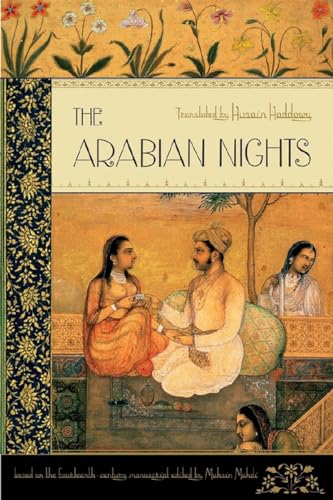
The Arabian Nights (Alf Layla wa Layla), Translated by Husain Haddawy

The Arabian Nights.  The Thousand and One Nights.  One Thousand and One Arabian Nights.  All of these titles serve as names for the fluid collection of Middle Eastern stories and folktales set in the framing narrative of storyteller Shahrazad to her husband, the king.

But let's back up a mo'.

Long, long ago (this is fictional), King Shahrayar got mad because his beloved wife cheated on him.  He was such a wreck afterwards that, not only did he have his wife and her lover maimed and killed, but he vowed to continue the bloodbath.  Every night, he married a new girl, bumped uglies with her, and killed her in the morning because EWWWWW!  Girls are the WORST!!!!

His vizier was...conflicted.  You see, contradicting a monarch in the Middle Ages anywhere was basically a death sentence, but perhaps most especially in this part of the world.  The king had had such a tantrum over his wife's infidelity that he took it out on other -innocent- women every.single.day.  It was just part of his journey.  


Indeed, for the vizier to suggest some alternate form of frustration relief would have been risky...and he was a fan of his own head.  Still, the vizier didn't like murdering innocent women and girls as part of his daily routine.  But it wasn't until his own daughter made a suggestion that he was willing to do anything about it.  Enter Shahrazad.

Shahrazad (often transliterated Scheherazade) was the eldest daughter of the vizier and she had an idea.  A bright, intelligent, and clever girl, she proposed to her father that she marry the king.  "QUOI?!?!?!?!?!  Hard pass", said her dad, the vizier.  No daughter of his was going to end up headless in the morning.  But Shahrazad was persistent and insisted that she had a plan.  Finally, her father reluctantly gave in, and granted her permission to marry the king.  The king, confused by this turn of events, consented.  His plans to kill her in the morning didn't change -and he made sure the vizier knew that- but he was curious to see where this whole thing was going.

After their wedding night festivities, Shahrazad began to cry.  Upon asking her why she was crying (for real) the king learned that his newly doomed wife had a younger sister, Dinarzad, whom she wished to see once more before dying in the morning.  So, King Shahrayar sent for Dinarzad to join them in the royal chambers.  I mean, he was a He-Man Woman-Hater, not a monster.

After the "king had satisfied himself with her sister Shahrazad" (ew), Dinarzad awkwardly cleared her throat and suggested that Shahrazad tell one of her "lovely little tales to while away the night".  She was, of course, not suggesting that her older sister tell campfire stories on the eve of her premeditated murder, but sticking to Shahrazad's well laid out plan.  You see, Shahrazad was a great storyteller...and King Shahrayar loved story time even more than he hated women.  Each night brought a new cliffhanger, so the king simply couldn't kill Shahrazad the next day or he'd never find out what happened next!  This went on night after night, week after week, month after month...until the king finally grew to love Shahrazad and agreed not to kill her.  Marital bliss.

It is this framing narrative that sets up every one of The Arabian Nights.  Stories within stories within stories within a framing narrative (another story) often require a little bit of focus to keep everything and everyone straight.  It's like the Middle Eastern folklore version of Inception.  While there are technically only 271 nights in my translation (which is about standard), the notion of 1,001 nights is actually more of a colloquialism in the Arabic language, the number 1,000 often being used to represent an infinite number (of nights/stories, in this case).  I was relieved when I learned this little factoid because (1) I couldn't find any translations that had 1,000+ nights and (2) I didn't want to read that many.  The 271 nights that I do have amount to over 500 pages, which was honestly enough for me.

In my research on this collection of stories, I learned a lot of other things, too.  For instance, many of the stories that we associate with The Arabian Nights (Alf Layla wa Layla, in Arabic) are not actually part of the original texts.  The thing about The Arabian Nights is that they are almost as flexible as the Arthurian Legends or stories of Robin Hood.  To find an "authentic original" is almost impossible as stories have been added and subtracted over the course of centuries.  In fact, the well-known stories of Sinbad the Sailor, Ali Baba and the Forty Thieves, and Aladdin were all added at later dates, some by European translators.  While the tales Sinbad, Ali Baba, and Aladdin are all equally of Middle Eastern origin, they were not part of the earliest iterations of The Arabian Nights.  For more on various translations, titles, and general information, check out this very thorough article: The Thousand and One Nights, Monica Mishra.

The translation I chose was by Husain Haddawy (copyright 1990), based on the fourteenth-century manuscript edited by Muhsin Mahdi.  The Mahdi manuscript seems to be something of a gold standard among variations, but that's just based on my own amateur observations.  Regardless, Haddawy's translation of this work is accessible and includes a very informative introduction by the translator about the evolution of the texts, manuscripts, and translations over the course of time.  It also includes a handy map of the world of The Arabian Nights, that covers territory spanning from modern day Egypt to China.


The Arabian Nights are, in many ways, surprising.  Prior to reading this translation, I had read a (very cleaned up!) children's version to my own kids a few years ago.  What I didn't realize is how graphic, violent, raunchy, and racist the original texts were.  While I wasn't surprised by the misogyny ("a woman needs either a husband or a tomb" -- or something like that), racism, and violence (they are of their time...), the sexual exploits and the ableism of the stories did leave me with my mouth agape.  But the 13-year-old in me laughed wildly at the poop and penis jokes, while simultaneously cringing at the villagers openly mocking and bullying the poor hunchback.

Ultimately, The Arabian Nights transported me to A Whole New World (sorry, couldn't help it) of magic, fantasy, and some weird-ass shit.  I laughed out loud, often having then to explain myself to others in the room; I winced at some of the ways the writers of these texts viewed the world; I rolled my eyes when "lovers" who knew each other for three hours had "affairs" (read: they looked at each other).  But I had fun and, even if you don't read The Arabian Nights in their entirety, I would recommend reading at least a few of them as stand-alone stories.  They are weird AF, but perhaps not as weird as the realities we experience every day.