Showing posts with label Myths/Legends/Folklore. Show all posts

January 29, 2025

2024 Wrap-Up: A record breaking 7-in-1 post

 I got lazy toward the end of 2024.  Part of it was that I had surgery in October, then still did all the usual year-end things...and I was just tired.  Being laid up, however, provided ample time for reading -- so read I did.  Because I am barraging you with seven new titles, I decided to group them by category.  You know how I love categories.

CHILDREN'S NOVELS

My daughter is always complaining about having "nothing to read" (false).  As a result, I have gone back into the deep recesses of my memory to dig up some of the books that I read and enjoyed around her age (give or take a couple of years).  Here are a couple that she read -and I re-read- in the final weeks of 2024.

Stepping on the Cracks, Mary Downing Hahn

I was fortunate as a child to have an older sister who was an avid reader.  This meant that she would often read books and then suggest the good ones to me, essentially weeding out the boring shit.  Stepping on the Cracks was one such "good book" that she recommended to me when we were kids.


The story is set stateside during WWII.  Two young girls -best friends Margaret and Elizabeth- both have older brothers fighting overseas, and know firsthand how war can affect a family.  Still, they are pre-teenage girls and war certainly doesn't occupy all of their thoughts.  In fact, the merciless sixth grade bully Gordy Smith and his cronies are more prevalent in their day-to-day lives.  In a scheme to exact revenge upon Gordy and his friends for their latest antics, Margaret and Elizabeth make a startling discovery that will change the way they think of their neighborhood as well as the world -and the war- around them.

Stepping on the Cracks is a simple but poignant coming-of-age story.  While most of us didn't live through WWII, we can relate to the youthful goings-on of the protagonists.  Re-reading this book as an adult was no less exciting, but certainly afforded me the opportunity to experience it through a different lens.  As an adult and a mom, I related to characters that I hadn't previously considered.  Well worth the re-read.

Cat Running, Zilpha Keatley Snyder

Another period-piece-lessons-learned novel that both my daughter and I enjoyed is Cat Running.  This story, set in California during the 1930s, features another sixth grade girl as the main protagonist.  Cat Kinsey is frustrated by her traditional parents -specifically her father- who will not allow her to "wear slacks" like the other girls at school.  It's not just the mandatory dresses that annoy Cat, but the fact that she is a very talented runner and wants so badly to defend her title in the school's annual running/track competition...but being unable to dress in a way that is conducive to her goals (and being a tweenage girl with an out-of-touch parent) makes that extremely difficult and frustrating.


As a salve to her rage, Cat discovers a strange little hideout in the rocky cliffs beyond her family's property.  As she sets up shop in her new secret place, she discovers that she is not the only one who frequents it...and a strange new friendship develops that might just change her life.  Fun, informative, and thought-provoking, Cat Running is a great story for the junior reader in your life.

MURDER MYSTERIES (A.K.A. "HOT DOG BOOKS")

Y'all, I'd be remiss if I didn't have at least one (or three) murder mysteries in my 7-in-1 post.  They need no introduction, so I'll just get started...

Miss Morton and the Deadly Inheritance, Catherine Lloyd

Devotees (ha!) will recall a series that I began in 2023: the Miss Morton books by Catherine Lloyd.  Deadly Inheritance is the third book in this series and follows the same format as the first two:  Miss Morton and the English House Party Murder and Miss Morton and the Spirits of the Underworld.  Honestly, I don't feel like it merits a full review because it's just the same formula.  It's predictable, fun, and I don't care what you say, I'm going to keep reading them.


Death Comes to the Village, Catherine Lloyd

Prior to the Miss Morton books, Catherine Lloyd penned a series of Death Comes to ____ books, featuring a practical, similarly minded leading lady:  Lucy Harrington.  Once again, "devotees" (double ha!) will recall that I began this series back in 2023, but unknowingly started with #3 of an eight book series.  (Previously read: #3 Death Comes to Kurland Hall and #4 Death Comes to the Fair.)  Since I've been doing a lot of hot dog reading in my convalescence (gearing up for another surgery next week...), I figured I ought to go back and start this series from the beginning with #1 Death Comes to the Village, and work my way through this series (skipping #3 and #4).  So far, same song and dance: fun, mindless, love mine with mustard and relish.


Vera Wong's Unsolicited Advice for Murderers, by Jesse Q. Sutanto

In a surprising turn of events, I left England's murdery countryside and landed in present day San Fran's Chinatown.  Stereotypical tiger mom Vera Wong runs a little tea house where nothing exciting happens...until one day, a man's body is discovered right in the middle of her shop.  Of course, the police department isn't up to snuff, so Vera must take over the investigation herself so that things will be done correctly.  As she continues her detective work, Vera finds herself cozying up to a laundry list of suspects, all people who knew the deceased.  What she doesn't expect is to find herself caring deeply for these people, their lives, and their well-being.


My husband and I listened to this book together (vs reading it in print) and, let me just say, we fully enjoyed it.  It was funny, suspenseful, and heartwarming -- a rare combination.  I would recommend Vera Wong to anyone who might enjoy a fun escape, particularly accompanied by a good cup of Chinese tea.  (Bonus:  Vera will be back in another novel set to release in March!)

MISCELLANEOUS (FANTASY + SHORT STORY)

The final two entries for this post fall into two separate categories.

Taliesin, by Stephen Lawhead

Last year, I listened to a Stephen Lawhead book In the Hall of the Dragon KingIt was OK, kinda contrived, not my favorite.  Still, I mentioned in that review how I wanted to try another couple of Lawhead's books/series, so I did.  Taliesin is the first in The Pendragon Cycle, a series featuring a cast of Arthurian characters.  


An epic build up to what is certain to be quite the universe, Taliesin spans perhaps an entire continent between Atlantis (a kingdom in its twilight) and a post-Roman Celtic world (that sounds a lot like Wales) that is on the rise.  Worlds collide, characters meet, years pass, and loved ones are lost or changed.  It's all the things that a fantasy prequel promise to be.  Nevertheless, I did find a lot of contrived action similar to that which I detailed in my review of Dragon King.  There were elements that were simply too forced for my liking, as well as a lot of "by the way" information crowded into the final chapters.  While it wasn't a bad read, per se, I will not be likely to pick up the second book in the series.  

The Turbulence Expert (from You Like It Darker), by Stephen King

My husband is a long time fan of Stephen King.  In fact, I believe he has read everything the guy has written.  (If not, it's pretty damn close.)  One of King's latest publications is a series of short stories in the book You Like It Darker.  


My husband hates flying; he hates heights.  As such, he related a great deal to the main character in the short story The Turbulence Expert from this collection and prompted me to read it, since I know these details about him.  Without divulging too much, the main character in the story shares my husband's fears, making him a perfect fit for a (fictional???) job as a "turbulence expert".  And that is all I'll say.  A fun and eerie read that will take you only a matter of minutes.


And that concludes 2024!  I've already made considerable progress in 2025 and am about to wrap my fourth book.  I will probably be back to review throughout the year, but I make no promises at this time!

HAPPY READING!!!


October 28, 2024

Unfinished Business: Books I did NOT complete

 It isn't often that I will start to read a book and make the decision not to complete it.  Even if it's not great writing or the characters suck, I'm too stubborn to put it aside.

Except that I did just this three times in the past few months:

A Play of Piety, by Margaret Frazer

After reading the first few chapters of this book, I was just. so. bored.  I wanted to like it.  I tried to like it.  I just couldn't get into it.  Furthermore, I was not remotely invested in the characters and, looking ahead, I happened upon a scene where a dog is killed.  It's a merciful death, but still sad.  Pass.


Jacob Have I Loved, by Katherine Paterson

This book started off strong.  Paterson's narration is both pleasing and easy to read.  I enjoyed her exposition through the pathetic first person narrator about things from seasons to food to jealousy.  However, about halfway through the book, one of the worst scenes I've encountered in literature presented itself.  This scene is graphic, inhumane, and abhorrent.  I found myself wishing I could strangle Paterson myself for putting these pictures in my head and now, without hesitation, I can say that I hate both her and her work.  And her main character -the one with whom readers are meant to empathize- is a spineless, brainless, piece of excrement.  No wonder everyone loves her sister and simply tolerates her.  She sucks.  HARD PASS.

Tales of King Arthur, by Sir Thomas Malory,
Edited and abridged with an introduction by Michael Senior


I've read a number of Arthurian legends.  I've known many of the stories for years and years but it wasn't until I was in a French literature class that I actually read my first original work.  We read Le Chevalier au Lion (The Knight with the Lion) by Chretien de Troyes.  On each two-page spread of the text were the old, original French (left page) and the updated, modern French (right page).  With a sort of dual-language book like this, we could not only read the story, but compare and contrast the current words with the original.  It was one of my first novels in French and that fact, coupled with the type of lyrical writing even of the modern translation, made reading the story of Sir Yvain as a knight errant rather cumbersome.  Nevertheless, we carried on.  I had also read -in both English and French- the story of Tristan et Yseut (Tristan and Isolde), along with numerous other adaptations of different stories of Arthur and his knights.

While I do love the adventures and the kickass stories themselves, after awhile, they start to drone on.  Malory is very very wordy, and his characters are quite flat.  For instance, Arthur is always perceived as a hero...even though he casts a ship full of babies out to sea, leaving them to die in case one of them is his repudiated son Mordred.  Sorry, Art, but that's not a redeemable act.  Merlin coerces a teenage girl into doing...things with him and, when the bill finally comes due (read: she enacts her own justice), she is the one painted as a villain while poor Merlin is victimized.  Barf.  Morgan le Fay is, as always, portrayed as a toxic malevolent when, let's get real, it was Arthur's birth father (Uther Pendragon) who killed her father, forced her mother to marry him, and then was a general asshole.  Maybe Morgan is nasty, but she's got her reasons.  All in all, the more I read of King Arthur, the more I tend to empathize/sympathize with the alleged bad guys.  You might say that the writings are "of their time", but I am also of my time.

This edition of Sir Thomas Malory's accounts is a great start for readers new to the Arthurian legends.  It's a challenging read, but simplified in order to appeal to a modern reader without having to do too much research or investigating.  In fact, that is exactly what Michael Senior (editor) intended: to create a loyal rendition of Malory's work that is also pleasing to read.  I would say he accomplished his mission; I just simply could not read the entire thing cover to cover without breaks to read other stuff.

Three books - each unfinished.  I have to remind myself when I pick up a book that I am under no obligation to finish it.  Sometimes, you just don't, and that's OK.  I've moved on since then, even finishing a couple of other books in the meantime.  Stay tuned for more reports on books that I have completed.

September 16, 2024

Elements of Cadence, a two part series by Rebecca Ross

 You guys know me by now, I think.  You know that I like fairytales, multi-faceted characters, elements of mystery, and -yes, I must confess- a drop of romance.  

Several months ago, one of my students paid me a great compliment: she recommended a book to me.  Yes, I know, anyone can recommend a book BUT, she recommended a book to me because she knows what I like and made her suggestion based on that.  What better compliment than to show that you know a person well enough than to offer them an adventure that is likely to please?

This student suggested that I read A River Enchanted, by Rebecca Ross.  At the time, I was not aware that this was the first in a duology.  It appears that both books were published in 2022, so I imagine they could be read like one great big mega book.  I listened to A River Enchanted on the Libby app and, upon discovering that it was the first of two, I immediately reserved the sequel, A Fire Endless.  So, some time lapsed between the two, but not enough for me to forget important plot elements.


Set on the fictitious island of Cadence, one can easily imagine this place as a far northern, remote location of Scotland.  In fact, the reader is Scottish (or at least reads with a Scottish accent, even during the book's credits), "the mainland" is often referenced, and the characters' plaids and kilts are frequently described.  "The Folk" (fairies/spirits) play huge roles throughout both of these novels, so they are -at the very least- inspired by Celtic legends and folktales.  And I love that.

We begin the story with Jack, a fatherless child of Cadence, whose mother had sent him to the mainland ten years prior to go to school and learn to become a bard.  In this time and place, a bard is a very prestigious position, reserved only for those who are very gifted in the art of song and storytelling.  Jack is summoned back home to Cadence -much to his chagrin- when he is around 20 years old.  Upon his return, we meet his family and the three other characters who will serve as the main ensemble for the rest of the duology: Adaira (heiress to the Tamarlaine clan lairdship), Torin (head guardsman, cousin of Adaira), and Sidra (talented healer, wife of Torin).  These four characters -Jack, Adaira, Torin, and Sidra- will continue to drive the plot for both books.  (Of no particular note: Sidra is my personal favorite.)

We also learn that the Isle of Cadence is split between two warring clans: the Tamarlaines in the East (clan to which our four protagonists belong) and the Breccans in the West.  The East has been blessed with bounty, light, and music, but they are often invaded by the West for their crops, livestock, and goods.  The West is a cold, desolate place where the people are hardened and desperate enough to invade the enemy territory in the East.  Still, the West has been gifted access to certain types of magic with little cost, rendering them all the more lethal to the East.

When Jack is summoned back to the East from the mainland, he soon learns the reason why.  Young Tamarlaine girls have begun disappearing and the heiress Adaira believes the spirits of the isle are behind it.  If nothing else, they might know why and where the girls are being taken.  But, in order to summon the spirits, a bard is required.  As the Tamarlaine clan has not had a bard since the death of Adaira's mother, the heiress is compelled to ask Jack to come back and sing for the spirits so that she can ask them for wisdom regarding the disappearance of the girls.  Reluctantly, Jack agrees to help.

Mysteries are solved.  Dark secrets are revealed.  Adventures are had.  It's a great fantasy read that incorporates so many of the things that I love about a good book and, as such, I would highly recommend the Elements of Cadence duology to anyone who is looking for a good escape.


July 22, 2024

Percy Jackson: The Lightning Thief, by Rick Riordan

Guys, you've heard me talk about Greek mythology before.

Hark back with me to 2005.  I was in college when a new young adult series was making its way onto the literary scene.  While I was indeed wrapped up in the then-contemporary world of Harry Potter, teenage wizard of great renown, a new series about some middle schooler learning he was half Greek deity was a touch "young" for my liking.  (OK, I didn't feel like I was above it, per se, just not particularly interested at that time.)  Anyway, I'd heard of them, but never bothered to pick up any of the Percy Jackson books.

Fast forward to February of 2023.  For about three years, my family had purchased season passes to our local children's theater, where stage adaptations of books are very common.  That winter, we saw a production of The Lightning Thief: The Percy Jackson Musical.  For whatever reason, this particular performance really sparked an interest in Greek mythology for my kids, especially for my daughter.  After the show, we went to a nearby Starbucks, got our favorite drinks, and talked about the musical.  It was at that point that I began telling my kids all the stories I recalled loving in my childhood and adolescence: epic mortal adventures, family feuds among the Olympians followed by unity when facing the Titans, their common enemy.  My kids sat, rapt with attention, listening to my every word, asking intelligent questions, impressed with their mother's vast knowledge (it isn't) of such a badass topic.  It was an historic event, like a comet that appears every 200 years.  Even my husband was into it.  It was a special moment in my life that I will never forget.

Anyway, as you know, we continue to be a mythology loving crew.  Later in 2023, when Disney+ came out with a new Percy Jackson series, my daughter got really into it, and so did I, by extension.  (Seriously, I felt like it was very well done.)  Soon after, her class had a unit on mythology at school, and she dominated it, knowing far more than even her teacher.  So, I felt like maybe I ought to pick up this book and read it myself.


I already knew the story, having seen a few different renderings of it on the stage and the screen.  I have a pre-established knowledge and understanding of the "who's who" in Greek mythology, and certainly a predilection for it.  The book did not disappoint!  It was great fun for me from start to finish, even knowing how it would end.  (On that note, may I just reiterate the quality of the Disney+ series?  Sure, they may have changed a couple of things and the cast doesn't always match the physical descriptions of the characters in the book, but it really captures the spirit of the novel.)

Without giving too much away, the first of the Percy Jackson series introduces us to to the titular character.  A young tween living in New York, Percy is the son of Sally Jackson and [question mark].  Percy struggles with a number of things including dyslexia and ADHD, although the reasons for these are later explained to him.  He has bounced around between schools for as long as he can remember, always getting into trouble, despite trying his best to avoid it.  When unexplained phenomena begin occurring at his current school, things take a new turn that even Percy couldn't have imagined.  Upon learning that he is a "half-blood" (a demigod: half human, half Greek god), the world of mortals becomes so dangerous for him that he ends up moving to a special place for kids like him.  Camp Half-Blood is a training facility and home for (wait for it) half-bloods, that is safeguarded against the particular sorts of mythological monsters bent on destroying the mortal children of the Olympians.

But even Camp Half-Blood can't protect him forever.  Inter-Olympian struggles are brewing that threaten the entire planet, and Percy's very existence lies at the heart of it.  Along with friends -new and old- Percy is destined to set things to rights.  In so doing, he learns the identity of his father and discovers an entirely new side of himself.  It's a great coming-of-age sort of adventure, fun for kids and adults alike...

...especially for the mythology-loving nerds among us.

July 6, 2024

Norse Mythology, by Neil Gaiman

Do you remember how much I love mythology?  Of course you do.  You're my number one fan.

But I'll recap:  I fell in love with Greek mythology as a young child when my babysitter brought over this book.  In fact, my sister and I loved it so much that it became part of our regular routine to read Greek mythology when this particular babysitter came over on the occasional Friday night.  I, for one, was smitten with the imagery and the stories of all the weirdos, human and deity alike.

This love didn't fade with age.  In fact, I found myself gleefully anticipating any English class in middle school, high school, and college that incorporated the classics.  It is a love that I have been able to pass along to my own kids, who share my enthusiasm for stories of heroes, Titans, and Olympians.

In more recent years, I have cast my net wider to include mythology from other parts of the world.  Among these are the legendary Norse gods, like those I mentioned from this book.  As previously stated, this pantheon of goons is slightly more likeable than their Olympian counterparts...and certainly sillier.  If the Olympians are your self-aggrandizing, prone to violence, and unstable relative, then the Aesir/Vanir are your abrasive, crass, obnoxious -but sort of well-meaning- drunk uncle.

Long before I picked up any anthology on the myths of Scandinavia, a particular book loomed on my "to read" list:  Norse Mythology, by Neil Gaiman.  I finally got around to reading it.


Most people know that Neil Gaiman is a successful writer of great acclaim (Coraline, Stardust, Good Omens, among others).  Indeed, he is also an artful storyteller, compiling the myths and legends of the Norse pantheon into one fluid narrative.  Norse Mythology is written so that it can be read like a novel with, more or less, a chronology that is easy to follow.  This flow lends a continuity to the stories that is otherwise lost when they are read serially or at random.  For a Type A personality like mine, this is a gem, and it makes this particular publication ideal for those who are new(ish) to Norse mythology.  We begin with Yggdrasil (the World Tree) and the nine worlds; we end with Ragnarok, the prophesied apocalyptic event that leads to the fall of Valhalla and the end of the Norse gods.  In between are the stories of the Aesir and the Vanir along with their (mis)adventures among the Jotun and the dwarves.

It's tremendous fun.

I happened to listen to this book rather than read it.  Listeners are in luck, as Gaiman narrates the book himself.  I typically appreciate it when an author narrates his/her own work as it really preserves the writer's voice in a way that might be lost in translation with a different reader.  Whether you read it or listen to it, Gaiman's voice is present throughout in a playful way, particularly in his telling of the story of Loki at Skadi's wedding.  Tasked with making the bride (Skadi) laugh, Loki does one of the dumbest things imaginable: he ties his balls to the beard of a goat.  It goes about how you think it would go and, yes, Skadi laughs.  (As do we all, Skadi.  As do we all.)  Incidentally, the D'Aulaires deftly skirt this more graphic story in their Book of Norse Myths by simply stating that Loki "tied himself to its [the goat's] beard".  There is no mention of genitalia, making this version more suitable for younger children...although mine roared with laughter at the mention of Loki's twig and berries.


Norse Mythology is an excellent retelling of some of the greatest stories to transcend time.  Neil Gaiman certainly doesn't disappoint as he calls upon readers to make the stories their own by retelling them to those who would listen.  (What a lovely thought!)  My one and only complaint about his retelling of Norse myths is that Gaiman doesn't spend nearly enough time on Freya's cats.  I can only assume he is presently working on the sequel, detailing the importance of these majestic floofs.

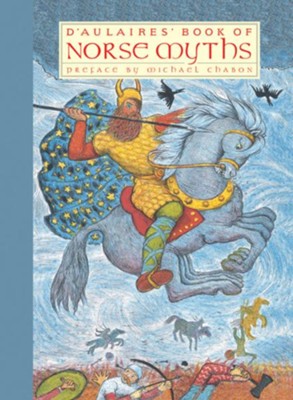
D'Aulaires' Book of Norse Myths, by Ingri and Edgar Parin D'Aulaire

NOTE:  I wrote this post MONTHS ago but, for some reason, it never got published.  So, I suppose it makes sense in tandem with the review that I am presently writing on Neil Gaiman's Norse Mythology.

Hooray!  It finally arrived!

Returning readers may recall (Ooo!  Alliteration!) my deep and abiding love for Greek mythology, owed almost entirely to a childhood babysitter and this book that I wrote about back in April (2023):

When I finally purchased my own copy -decades later in life- I learned that the D'Aulaires had co-written/illustrated even more world myths.  While I have a solid handle on Greek mythology, I do enjoy branching out and learning about the legends, folklore, myths, and fairy tales that come from other parts of the world.  Over the years, I have enjoyed a vague familiarity with Norse mythology, but I haven't spent nearly as much time with the pantheon of old-timey Scandinavia.

Until now.


No matter which way you look at it, the Olympians of ancient Greece are assholes.  Truly.  There isn't one among them without the stain of atrocity on his/her sleeve.  They are absolute train wrecks.  Imagine your most unstable relative - you know, the one who always blows up at holiday celebrations and ends up yelling at the kids.  Now imagine that relative is immortal and has unlimited power and drinks too much and exists in a dozen different beings.

Welcome to Mount Olympus.

The Norse gods are, for all their faults, slightly different.  They have immensely long lives, but know that their days are numbered.  They are discombobulated, unorganized, misogynistic (although somewhat less so than their Greek counterparts), and waaaay too into war (Excuse me, sir, do you have time to talk about Valhalla?), but they know that Ragnarok is pending and they want to get their shit together before it comes.  

Like their Olympian cousins, however, the Aesir are one hot mess.  (And so are the Vanir -a separate but related tribe/grouping of Norse gods- although I'd argue they are nutters to a moderately lesser degree.)  They fight with and deceive one another, but they share an overall goal for themselves and vision for humanity.  They seem a little more human than the Olympians, even though they are sometimes actual animals/monsters (literally -not figuratively- speaking).

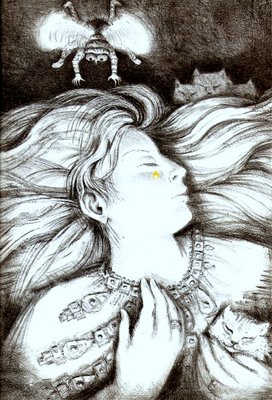
From the entirety of both the Greek and Norse pantheons, however, one deity rises high above the rest.  Say what you will about her "profession" as the Norse goddess of love, beauty, fertility (also war, death, magic, lust, gold, according to other sources), Freya is BY FAR THE BEST OF THE BEST.  Here is why:


Do you see that?  In case you missed it, let me point it out again:


OK, one more time, just to be sure (Freya is just to the right of center):


Freya seems to be almost synonymous with HER CATS.  For this reason -and this reason alone- I want her to be my best friend.  Why is she always depicted with cats?  Scroll back up to the first image and you'll see something that only a divine being could do.  Freya's chariot/sled is pulled by cats.  Not huskies, not horses, not reindeer or donkeys or even Thor's famed goats.  Cats.  Say it again with me:  CATS.  The best part is that this isn't even the D'Aulaires taking some artistic license.  Since her inception, this honorary Aesir (originally one of the Vanir) has been chauffeured by cats.  Google it.

Loki is weird.  Thor is hilariously oafish.  Odin thinks he's sneaky (he's not).  No doubt about it, this pile of goons and faulty deities are laughable and wonderful in their own right.  I'm not sure who would win in a battle of the Olympians versus the Aesir (+/- Vanir), but I do know one thing:  Freya and her cats will ALWAYS win in my book.  And my kids agree, because science has indisputably proven the following:

Cats > Everything else


August 14, 2023

Odysseus in the Serpent Maze, by Jane Yolen & Robert J. Harris

Here I am again, returned to one of my original themes, one of the themes that first ignited, and later kindled, my love of stories as I made the slow, steady transition from childhood to adolescence:  Greek mythology.

But it isn't my adolescence that we're going to discuss, rather that of Odysseus and his (future) wife, Penelope; that of his lifelong best friend and behind-the-scenes protector, Mentor; that of Helen of Sparta (later "of Troy"); that of Idomeneus, prince (later king) of Crete.  In a reimagining of the younger years of arguably the final true hero of ancient Greece's "Age of Heroes", wily Odysseus and his friends set off on a series of accidental adventures that will shape the remainders of their (already fictitious) lives.  Powerhouse Jane Yolen (The Devil's Arithmetic, How Do Dinosaurs...?, Owl Moon, Children of the Wolf, and hundreds more that you probably read growing up) and author Robert J. Harris (Artie Conan Doyle Mysteries, The World Goes Loki series, Young Legends, Young Heroes), team up for Odysseus in the Serpent Maze by taking all we know about the Ithacan king's famed life on the ancient Mediterranean and rewinding the story to his early teenage years.  


We begin with Prince Odysseus and his pal Mentor getting lost at sea on their way home to Ithaca after a visit with Odysseus's grandfather, Autolycus.  After being adrift for days, they are picked up by pirates, who are holding two important captives aboard their ship:  Princess Helen of Sparta and her cousin, Penelope.  The famous foursome spend the rest of the novel making their way home, but certainly not easily.  Without too many spoilers, fans of Greek mythology will be pleased to see some old friends, including the irresistible sirens, the genius Daedalus and his apprentice Praxios, King Deucalion (son of King Minos of Labyrinth and Minotaur fame), the goddess Athena, Silenus the satyr, the monstrous serpent Ladon, along with the "wine-dark sea"* and "dawn" with her "rosy fingers"* (*taken directly from Homer's Odyssey).

It was, once again, my daughter who requested commanded me to read this book after getting a free copy of it to keep from her school library.  Copyrighted in 2001 (2000 say some sources?), I later learned that this is the first of the collaborative efforts between Yolen and Harris on ancient Greek heroes.  Their Young Heroes series includes a number of famous Greek protagonists:  Hippolyta and the Curse of the Amazons, Atalanta and the Arcadian Beast, Jason and the Gorgon's Blood.  Being quite the fan of Atalanta herself, I may have to recommend these to my Greek mythology-loving daughter!  Regardless, Yolen and Harris do a lovely job of humanizing the characters in Odysseus in the Serpent Maze.  More often than not, it is easy to forget that the characters of the ancient world were, first and foremost, humans (or, at the very least, created by humans).  The heroes of old were not always heroes; they were children first.  And, despite Odysseus's hatred of being referred to as a "boy" in this book, at age 13, he totally is.

Fun, accessible, and clearly crafted with love and acknowledgment of the original myths, Odysseus in the Serpent Maze is simply an enjoyable read for fans -young and old- of Greek mythology.

June 11, 2023

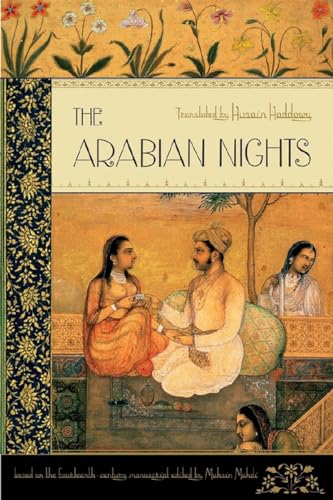
The Arabian Nights (Alf Layla wa Layla), Translated by Husain Haddawy

The Arabian Nights.  The Thousand and One Nights.  One Thousand and One Arabian Nights.  All of these titles serve as names for the fluid collection of Middle Eastern stories and folktales set in the framing narrative of storyteller Shahrazad to her husband, the king.

But let's back up a mo'.

Long, long ago (this is fictional), King Shahrayar got mad because his beloved wife cheated on him.  He was such a wreck afterwards that, not only did he have his wife and her lover maimed and killed, but he vowed to continue the bloodbath.  Every night, he married a new girl, bumped uglies with her, and killed her in the morning because EWWWWW!  Girls are the WORST!!!!

His vizier was...conflicted.  You see, contradicting a monarch in the Middle Ages anywhere was basically a death sentence, but perhaps most especially in this part of the world.  The king had had such a tantrum over his wife's infidelity that he took it out on other -innocent- women every.single.day.  It was just part of his journey.  


Indeed, for the vizier to suggest some alternate form of frustration relief would have been risky...and he was a fan of his own head.  Still, the vizier didn't like murdering innocent women and girls as part of his daily routine.  But it wasn't until his own daughter made a suggestion that he was willing to do anything about it.  Enter Shahrazad.

Shahrazad (often transliterated Scheherazade) was the eldest daughter of the vizier and she had an idea.  A bright, intelligent, and clever girl, she proposed to her father that she marry the king.  "QUOI?!?!?!?!?!  Hard pass", said her dad, the vizier.  No daughter of his was going to end up headless in the morning.  But Shahrazad was persistent and insisted that she had a plan.  Finally, her father reluctantly gave in, and granted her permission to marry the king.  The king, confused by this turn of events, consented.  His plans to kill her in the morning didn't change -and he made sure the vizier knew that- but he was curious to see where this whole thing was going.

After their wedding night festivities, Shahrazad began to cry.  Upon asking her why she was crying (for real) the king learned that his newly doomed wife had a younger sister, Dinarzad, whom she wished to see once more before dying in the morning.  So, King Shahrayar sent for Dinarzad to join them in the royal chambers.  I mean, he was a He-Man Woman-Hater, not a monster.

After the "king had satisfied himself with her sister Shahrazad" (ew), Dinarzad awkwardly cleared her throat and suggested that Shahrazad tell one of her "lovely little tales to while away the night".  She was, of course, not suggesting that her older sister tell campfire stories on the eve of her premeditated murder, but sticking to Shahrazad's well laid out plan.  You see, Shahrazad was a great storyteller...and King Shahrayar loved story time even more than he hated women.  Each night brought a new cliffhanger, so the king simply couldn't kill Shahrazad the next day or he'd never find out what happened next!  This went on night after night, week after week, month after month...until the king finally grew to love Shahrazad and agreed not to kill her.  Marital bliss.

It is this framing narrative that sets up every one of The Arabian Nights.  Stories within stories within stories within a framing narrative (another story) often require a little bit of focus to keep everything and everyone straight.  It's like the Middle Eastern folklore version of Inception.  While there are technically only 271 nights in my translation (which is about standard), the notion of 1,001 nights is actually more of a colloquialism in the Arabic language, the number 1,000 often being used to represent an infinite number (of nights/stories, in this case).  I was relieved when I learned this little factoid because (1) I couldn't find any translations that had 1,000+ nights and (2) I didn't want to read that many.  The 271 nights that I do have amount to over 500 pages, which was honestly enough for me.

In my research on this collection of stories, I learned a lot of other things, too.  For instance, many of the stories that we associate with The Arabian Nights (Alf Layla wa Layla, in Arabic) are not actually part of the original texts.  The thing about The Arabian Nights is that they are almost as flexible as the Arthurian Legends or stories of Robin Hood.  To find an "authentic original" is almost impossible as stories have been added and subtracted over the course of centuries.  In fact, the well-known stories of Sinbad the Sailor, Ali Baba and the Forty Thieves, and Aladdin were all added at later dates, some by European translators.  While the tales Sinbad, Ali Baba, and Aladdin are all equally of Middle Eastern origin, they were not part of the earliest iterations of The Arabian Nights.  For more on various translations, titles, and general information, check out this very thorough article: The Thousand and One Nights, Monica Mishra.

The translation I chose was by Husain Haddawy (copyright 1990), based on the fourteenth-century manuscript edited by Muhsin Mahdi.  The Mahdi manuscript seems to be something of a gold standard among variations, but that's just based on my own amateur observations.  Regardless, Haddawy's translation of this work is accessible and includes a very informative introduction by the translator about the evolution of the texts, manuscripts, and translations over the course of time.  It also includes a handy map of the world of The Arabian Nights, that covers territory spanning from modern day Egypt to China.


The Arabian Nights are, in many ways, surprising.  Prior to reading this translation, I had read a (very cleaned up!) children's version to my own kids a few years ago.  What I didn't realize is how graphic, violent, raunchy, and racist the original texts were.  While I wasn't surprised by the misogyny ("a woman needs either a husband or a tomb" -- or something like that), racism, and violence (they are of their time...), the sexual exploits and the ableism of the stories did leave me with my mouth agape.  But the 13-year-old in me laughed wildly at the poop and penis jokes, while simultaneously cringing at the villagers openly mocking and bullying the poor hunchback.

Ultimately, The Arabian Nights transported me to A Whole New World (sorry, couldn't help it) of magic, fantasy, and some weird-ass shit.  I laughed out loud, often having then to explain myself to others in the room; I winced at some of the ways the writers of these texts viewed the world; I rolled my eyes when "lovers" who knew each other for three hours had "affairs" (read: they looked at each other).  But I had fun and, even if you don't read The Arabian Nights in their entirety, I would recommend reading at least a few of them as stand-alone stories.  They are weird AF, but perhaps not as weird as the realities we experience every day.

April 11, 2023

D'Aulaires’ Book of Greek Myths, by Ingri and Edgar Parin d'Aulaire

I finally did it.  I got my hands on a hard copy of D'Aulaires’ Book of Greek Myths.  Actually, it's very accessible and readily available on Amazon; I just had to apply my powers of recollection to track it down.  Regular readers may recall that I mentioned this beautifully illustrated collection of Greek mythology in a previous post on Celtic Mythology for Kids (Pinard).  In that post, I mentioned my childhood babysitter Majel and how she sparked within me a deep love for Greek mythology.  This year, I was able to truly share that love with my own kids who begged me so often to tell them these stories that I found the most obvious solution that I ought to have come up with much sooner:  buy them this book.

The original publication of this book featured a bright yellow cover.

The modern publication features the same image on a black background.

Despite a few aesthetic changes to the cover, I found a paperback edition of this 1962 publication of retellings and illustrations by husband and wife duo Ingri and Edgar Parin d'Aulaire.  The 2017 copy that we now own features all of the gorgeous original illustrations along with an Afterword that includes biographical information about the authors/illustrators, along with some of their original sketches.  After being prodded daily to read from this book, I'd say we got our money's worth.  The retellings are accurate (from my understanding of the ancient myths) without being too graphic or explicit.  It's safe to say that Zeus was a ladies' man...but that consent from the other party wasn't exactly a requirement in his "relationships".  The d'Aulaires still share some of the darker aspects of mythology (think: Oedipus, Persephone, or -my personal favorite- Prometheus), but in a way that I would consider age appropriate.  While stating that Zeus "had a lot of wives" or "many children with women other than Hera [his main wife]" isn't the entire picture, it's enough for young readers.

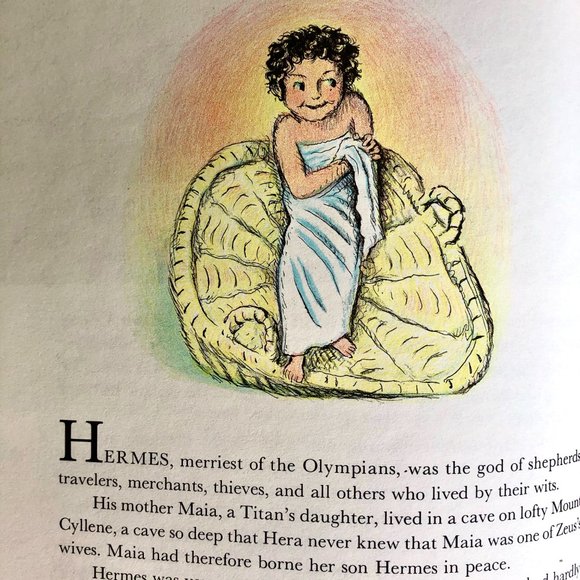
Kids will loves the story of Hermes, one of the few characters of the Greek pantheon we meet as a baby.  Clever, witty, and full of mischief, even the most austere of the Olympians are fond of him -- and so are we.  Pan, the ugly god of nature is reminiscent of SNL's "goat boy".  As unlikely as it sounds, Pan and the Olympian Apollo are equally unlucky in love as the objects of their desire (Syrinx and Daphne, respectively) opt to turn into plants rather than marry them -- an aspect of the story that my kids found wildly amusing.  And, despite its dark(ish) end, isn't it kinda funny that Narcissus wastes away and dies because he falls so deeply in love with his own reflection that he forgets to eat or drink?  Well, we thought so.  Dumb ol' King Midas turning his family into gold wasn't enough; he had to go make a big deal out of a music competition and ended up with donkey ears.  (Read it.  It makes sense.)  His ultimate demise recalls the story of Abou Hassan from One Thousand and One Nights.  [Quick Context Comparison:  King Midas is so ashamed by his donkey ears that he leaves his throne and flees to the woods.  Abou Hassan is a wealthy merchant who, at his elaborate wedding feast, lets out such a huge fart that he flees the country -leaving his beautiful new wife- for ten years on account of his embarrassment.]

Naughty baby Hermes is perhaps one of our family favorites.

The stories of ancient Greece are great.  Weird, often disturbing, and usually gross...but somehow great.  But it isn't just this fabulous publication that makes these stories as much fun as they are.  For me, there is a great deal of nostalgia involved.  Better yet, I get to share that with my kids now.  They crave these stories for their action and excitement.  We currently are loving a children's podcast called Greeking Out (National Geographic), where many of the same stories are told in different ways for kids.  My daughter loves listening to the tales of Atalanta and the wars between the Olympians and the Titans on repeat.  My son delights in the ingenuity of the Trojan horse. 

My oldest -ever the creator- made a family tree for the main Olympians
(and a few of their Titan ancestors).


There is truly nothing like getting to share great literature with the people you love most.  So we have this adventure on order...


March 3, 2023

Celtic Mythology for Kids, by Christopher S. Pinard

When I was a child, my sister and I had a smattering of babysitters over the years.  Some were better than others but, of those, a few stand out above the rest.  One of those was Majel.

I credit Majel with my love of the Classics -- most notably, my love of Greek mythology.  See, she had this book that she brought with her almost every time she babysat us.  It was chock full of myths and stories starring the ancient Greek pantheon and its heroes.  Like the fairy tales I so love(d), these stories were full of magic, adventure, and excitement.  AND there were pictures!  Most of all, my sister and I loved it when Majel read us the story of Perseus using the head of Medusa to rescue Andromeda from the giant sea turd.  Yes, you read that right.  This translation featured the sea "turd" (versus a sea monster or a kraken).  The illustration was even of a lovely girl, terrified and chained to a wall, as a giant piece of shit with a face stalked her from behind.  It was mesmerizing.

I FOUND IT!!! 
Majel read to us from D'Aulaire's Book of Greek Myths!! Look how it’s even tapered on the end in the background. Looks like shit to me! Is it wearing lipstick?


Anyway...

The Greeks are so great.  But you know whose stories are equally great?  The Celts!  I didn't grow up exposed to Celtic mythology in the same way, but I do have an innate love of leprechauns, Scottish wild cats, and the modern Celtic people, so I felt it was high time to explore that in a literary sense.  Under the guise of "getting a present for my kids", I looked up anthologies of Celtic mythology for children and found this gem of a book.  


Collected and curated by writer Christopher S. Pinard, these stories come to us from a variety of ancient and modern Celtic lands:  Ireland, Scotland, Wales, and Brittany (France).  Pinard divides them into the following categories, making for a nice linear read:  Mischief Makers and Monstrous Fakers, For Love Alone, Landscapes in Celtic Folklore, and Into the Wide and Wild World.  Of course, each of the stories can be read as a stand alone, but I have a mind that operates at its finest in the concrete; I like organization.  The end of a book features a Celtic glossary with definitions of some of the lesser known terms used throughout the book (i.e. hogney, Slievenamon, etin).  

My personal favorite feature of this glossary is the pronunciation guide.  As a linguist and eternal studier of languages, I like to learn words the right way.  Take the character of Niamh, for instance -- the wife of Oisin and princess of the otherworld.  I never would have guessed at these characters' actual names beyond "Nee-ahm" or "Oy-zin" but I'd have been profoundly off:  Niamh (Neev) and Oisin (Oh-sheen).

So many of these Celtic stories remain little known to the general population (around me, at least), yet they influence much of the fantasy writing and literature that we know even today.  It's impossible not to notice the parallels between the worlds of the elves and high kings and the populations of Tolkien's Middle Earth.  Furthermore, we might also observe similarities between the Celtic connections to the natural world and the importance of nature in the stories of America's First Peoples.  The lessons of many of the tales within this book ring true even today:  Don't judge someone by their appearance.  Be wise in your dealings with strangers.  It is important to keep our promises.  Jealousy can harm our relationships with others.  In addition to these lessons, Pinard includes conversational questions to at the end of each story to aid the development of critical thinking in youngsters.

Between the stories themselves, their thematic arrangement, the glossary of terms, and the "Questions to Think About", this book is ideal for introducing children (and adults!) to Celtic mythology.  Add to that the unique and vivid illustrations of artist Javier Olivares and you have a complete literary adventure to share with children...or the young at heart.

February 26, 2023

Les Contes de Perrault, by Charles Perrault

When we think of classic fairy tales, those of us in the U.S.A. often conjure up images of Disney movies, Shrek, or even the Grimm's Fairy Tales we heard as children.  While these are certainly relevant sources, we often leave out Charles Perrault, who delivered Mother Goose herself to the 17th century.

Like most other fairy tale writers, Perrault did a great deal of "collecting" of common fairy tales of his day.  Oftentimes, these stories were shared orally, and were passed through the generations by way of storytelling.  This would obviously lead to problems of continuity; it is thanks to fairy tale "collectors" like Perrault, the Grimm brothers, and Andrew Lang that we have many of these stories with us today in the ways we have come to commonly recognize them.

That being said, I would argue that many fairy tales lack a single, obvious, original author.  Beauty and the Beast, for example, has elements that appear as far back as ancient Rome in accounts of "a feast that served itself".  While we all can recognize that scene in a snap, the rest of the story as we know it would have been entirely different in the ancient world.  It wasn't until the mid-18th century that the modern version of this fairy tale (of movie acclaim) would be penned by Gabrielle-Suzanne Barbot de Villeneuve.  Even since that time, the story has evolved into something new and different.  Guys, there are songs now.

It seems to me that every culture worldwide has some type of Cinderella story.  In China alone there are differing versions but, perhaps the best known is that of Beauty and her one evil stepsister, Pockface.  (I know.)  The Algonquin people have the story of The Rough-Face Girl, whose cruel sisters force her to stoke the fire day and night, causing sparks to permanently mar her hair and skin.  Ultimately, her inner beauty wins when the Invisible Being sees her for the kindhearted person she is and marries her, shaming her sisters and their inner ugly.

Even our own western tradition has different iterations of this classic tale.  The Disney movie is based on the version of Charles Perrault (France) while the Grimm version (Germany) is much more gruesome and violent.  Personally, I'm really glad that Cinderella's bird friends didn't peck out the eyeballs of her lying stepsisters in the movie.  It would have been a hard sell to the kids of the 1950s if the stepsisters cut off toes or heels to fit into the glass slipper while cute mice sang songs about making a lovely dress for Cinderelly.

[Side note: Cinderella gets her nickname because she sits among the cinders of the fire and is dirty as a result.  The nickname is similar in French: Cendrillon.  However, the nastier of the two stepsisters in Cendrillon actually calls her Cucendron, which could be roughly translated as "Cinderass".  This is my favorite thing in all of fairy tale bitchiness.]

The contes (tales) that I read in this particular publication appear in their original French.  I have listed them below in both their French and English titles.  You will likely recognize most of them, though many are not widely known to English speakers.

Les Contes de Perrault (The Tales of Perrault)

  1. Cendrillon (Cinderella)
  2. Le Chat Botté (Puss in Boots)
  3. Les Fées (The Fairies)
  4. Le Petit Poucet (Tom Thumb)
  5. Riquet à la Houppe (Riquet [proper name] with the Tuft [of hair, like a cowlick])
  6. La Barbe Bleue (Blue Beard)
  7. La Belle au Bois Dormant (Sleeping Beauty [of the Woods])
  8. Les Souhaits Ridicules (The Ridiculous Wishes)
  9. Petit Chaperon Rouge (Little Red Riding Hood)
Common themes I have noticed throughout these nine contes would include what we often think of with fairy tales:  Things aren't always what they seem.  Kindness triumphs over cruelty.  Appearances don't mean everything (with a caveat, explained in a moment).  These are all good lessons.

We must, of course, make some allowances for fairy tales.  They are often, by nature, the antithesis of our modern values.  Take, for instance, the notion that nearly every happy ending takes place with a wedding between relative strangers who fall instantly in love.  Obviously, this is not realistic.  Critics would cite this as problematic, but I don't feel so quick to point it out as a flaw.  We are, after all, willing to suspend our disbelief enough to allow for a talking cat with boots (OMG ADORABLE!!!) or a young girl who can fall asleep for 100 years and wake up without bedhead or dragon breath.  

While I can swallow the weddings equating to happy endings, I do struggle with some of the blatant misogyny apparent in these stories.  Remember how we said that "appearances don't mean everything"?  Evidently, this only applies to inanimate objects.  Without fail, the victimized female protagonists are always beautiful, in spite of their trashy, poor people clothes.  Even the young princess who is known throughout the kingdom for being pretty but as dumb as a rock (Riquet à la Houppe) comes out on top.  Her smart (but ugly) twin sister is forgotten within a sentence of being labeled as jealous once the pretty sister becomes smart.  You see, the good fairy who was present at their birth said that the pretty girl could magically become smart...but there wasn't really anything she could do for the UGLY smart one.  I mean, gross.  Her magic powers can only do so much.  The happy ending?  The pretty (and now smart, too!) sister gets married to the protagonist.  The (always) smart sister remains ugly, and is therefore not an integral part of the story.  So, I guess that means that, for women and girls, value is determined by beauty.  But we musn't forget that appearances don't mean everything...right?  

Fairy tales like these Contes de Perrault are of their time.  They are typically written by men -sometimes women- who were willing to perpetuate the the untruths at the base of the patriarchy so pervasive to their respective cultures.  Nevertheless, while the stories we tell are greatly indicative of our values and world views, they also help to shape us.  I like to think that we can laugh at the absolute absurdity of a mother who intentionally "got to work quickly [having children], and didn't make less than two at a time" (Le Petit Poucet).  

Despite these frustrating nuances, I still love the classic princess fairy tale stories.  I am a product of the 1980s-1990s Disney Princess Explosion and, to this day, I thoroughly enjoy a poofy dress and a tiara, but you know I'll be wearing sensible shoes.