Showing posts with label Mystery. Show all posts

May 2, 2025

Arsène Lupin: Gentleman-Cambrioleur (Gentleman-Burglar), by Maurice Leblanc

Bonjour, mes amis!  Autrefois, pendant cet hiver passé en fait, j'ai donné un cours de français où on lisait un roman ensemble:  Arsène Lupin: Gentleman-Cambrioleur.

Did you catch that?  Si oui - très bien, je vous félicite.  Sinon - well, don't worry about it. 😉

Translation:  Hello, my friends.  Awhile back, during this past winter actually, I taught a French class where we read a novel together:  Arsène Lupin: Gentleman-Burglar.


As both of you know, I am a French teacher.  I teach college/grad level content for an international (though non-accredited) institution, mainly for people who simply love to learn.  It's a great gig and I love my job.  We have three annual "school year" sessions that meet weekly and, during the Winter Session, I like to either read a novel or watch a TV series together, discussing various chapters/episodes each week in class.  At the request of a regular student of mine, we read this novel together - and it was a lot of fun!

For those of you not familiar with the character, Arsène Lupin is the star of his own series of short stories by Maurice Leblanc.  Set during the turn of the 20th century, Lupin is a criminal mastermind, a charming, rakish thief who makes his way around the world (usually Europe, but he comes to the US at least one time), mainly stealing jewels and baubles and money off of the wealthier classes.  Sometimes he is bested, but he always works his way out of it with his wit and a crew of faithful followers.  A master of disguise with a laundry list of aliases, Lupin has no shortage of tricks up his sleeve to change his appearance and identity, as he often does.

Maurice Leblanc penned his stories slightly after -and also contemporaneously with- the publication of stories starring another turn-of-the-century mastermind: Sherlock Holmes by Sir Arthur Conan Doyle.  In fact, Arsène Lupin crosses paths with a one "Herlock Sholmès" on occasion.  They are rather each other's opposites (one being a thief, the other a detective), but share a great deal in common (brilliant minds, a love for puzzles, bleeding narcissism).  Of course, as the creator of Arsène Lupin, author Maurice Leblanc favors his own brainchild and Lupin bests "Herlock".

While the stories certainly have a similar feel to those of Sherlock Holmes, the anti-hero reigns supreme here.  Some stories are humorous, others less so.  Lupin is definitely not a "good person", but he does have redeeming qualities and a backstory that elicits empathy from the reader.  He rather calls to mind the image of Hercule Flambeau from the BBC series Father Brown.  (From my understanding, the character of Flambeau is portrayed rather differently on the series from his original version in the G.K. Chesterton books of the same title.  Lupin reminds me somewhat of a younger version of the TV portrayal of Flambeau.)

Hercule Flambeau, Father Brown on BBC

The edition we read together in class was a dual-language one, featuring the original French text alongside its American-English translation.  We quickly learned that the translation was not spot on, much to our annoyance.  Still, for readers of a second language, having quick-access reference to translations can be useful as it does not disrupt the flow of reading as much as having to seek a dictionary translation would.

All in all, Arsène Lupin: Gentleman-Cambrioleur makes for a fun, escaping read.  It isn't high brow or particularly difficult, but fun all the same for lovers of the genre.

Bonne lecture!

April 26, 2025

Two Junior/Children's Novels: The Incorrigible Children of Ashton Place and Number the Stars

 You guys know that I like to read children's lit.  I love the straightforwardness of it, the speed of plot development, and the immediacy of any action from the characters.  Children's authors know their audience has a shorter attention span than many of their elder counterparts...

...so what's my excuse?


The Incorrigible Children of Ashton Place: The Mysterious Howling, by Maryrose Wood

Earlier this year, I recalled a series of books that a friend had recommended for my daughter, The Incorrigible Children of Ashton Place: The Mysterious Howling, by Maryrose Wood.  (What a name!  What a title!)


I must confess, the language the author uses is fairly highbrow for younger readers but, after a short period of acclimation, clever kids can handle it.  Without divulging too much, we begin this first novel of the series (of six books, I believe) with our protagonist, young Miss Penelope Lumley, who has just left her beloved school behind to become the governess to three children at Ashton Place.  Only it seems that these children are not ordinary in the least; they are positively feral.  As Penelope seeks to both teach and understand these "incorrigibles", she begins to discover that it is not only their past that is entirely mysterious, but that Ashton Place itself holds a treasure trove of secrets.

I listened to this novel as an audiobook rather than reading a hard copy.  What a treat!  Upon finishing it, I immediately placed the five subsequent titles in the series under my "To Read" tag on Libby (my preferred library app).  The mystery, humor, colorful language, and premise itself are sure to delight readers (or listeners) of any age.


Number the Stars, by Lois Lowry

Many, many years ago -some time in the late 90s- I read the book Number the Stars, by Lois Lowry.  This 1990 Newbery Award Winner didn't disappoint when I read it then, and it certainly didn't disappoint when I re-read it this past winter.


Lois Lowry masterfully crafts a concise -yet very poignant story- based on the life of a fictional young Danish girl named Annemarie.  Our heroine is growing up in Denmark under Nazi occupation.  The German soldiers situated all around her neighborhood are intimidating, often bullying those they stop to "question", so Annemarie and her sister have been instructed to avoid them as much as possible.  It isn't until Annemarie's Jewish best friend Ellen catches their attention that things get too close to home.

A fictional retelling of the Danish resistance's success in smuggling nearly the entire population of Jewish citizens out of the country to Sweden, Number the Stars is a story that lingers for its veracity.  I don't wish to ruin the ending for you, but the absolute ingenuity of this silent resistance is nothing short of incredible.  A short novel, yes, but one that reminds us that humanity can indeed be found anywhere.


Two great books for the kids in your life, but certainly don't let them have all the fun.

Happy reading!


April 15, 2025

Dark Water Daughter, by H.M. Long

Fantasy.  Adventure.  Mystery.  Magic.  Pirates.  Swords.  Ethereal creatures.  Cold AF weather.  

This book has it all.


Enter a strange and magical world of ghistings (ghost-like creatures who inhabit mystical forests), stormsingers (women whose voices have the power to conjure and calm storms on the seas), and swashbucklers (come on, you know this one).  

From the dust jacket:

Mary Firth is a Stormsinger: a woman whose voice can still hurricanes and shatter armadas. Faced with servitude to pirate lord Silvanus Lirr, Mary offers her skills to his arch-rival in exchange for protection - and, more importantly, his help sending Lirr to a watery grave. But her new ally has a vendetta of his own, and Mary's dreams are dark and full of ghistings, spectral creatures who inhabit the ancient forests of her homeland and the figureheads of ships.

Y'all, this book is weird.  And I liked it.  Despite some major lulls in the story, author H.M. Long creates an exciting world to lay the foundations for the first novel of The Winter Sea series.  Some of her characters are likable; some of them are deplorable; some of them fall in between; some you think you'll like/hate, but end up hating/liking.  Set on a series of islands in a frigid sea, the fantasy world Long has created recalls images of the northernmost islands of Scotland, Scandinavia, and even a few locations within the Arctic Circle.  It was a great winter read by the fireplace.

As I mentioned, there were a few major lulls in the story.  I finished it in January (roughly three and a half months ago, at the time of this writing) so, while I cannot recall specific dull points in the novel, I do remember finding it rather long in some parts.  Overall, the book did seem to drag more than I personally would have preferred, though I know that some people really get into the world-building thing.  There were also a few annoying tropes (e.g. What is Mary going to do in this precarious situation?  What about THIS one?  Oh yeah?  How about NOW?) that I felt really took away from the story's progression, but it wasn't bad enough for me to put the book down.  It was mostly just an annoyance until the next good part.

So, will I continue the series?  Sure.  It's not a top priority, per se, but I could see myself completing it.  Ultimately, I feel that any subsequent novels in the series would be better audio books for me.  That way, I can at least be doing dishes while I enjoy a good story in my ear.

March 29, 2025

Death Comes to [all the places], by Catherine Lloyd

Summer 2023.  I casually picked up a copy of Death Comes to Kurland Hall for less than $1 at my local library's used bookstore.  After I began reading this book, I realized that it was the third in a series of eight.  No matter, it was a simple read -a hot dog book- and the context of the characters in the story was well explained.  It's the type where you could start in the middle of the series and not be too lost.

Later that year, I picked up the next book in the same series, Death Comes to the Fair.  Same story of a purchase for chump change at the library bookstore.  After reading this fourth installment, I figured that would be enough for me - no need to continue the series.

Fast forward about a year, to fall 2024.  I decided, what the heck?  Let's just read the entire series.  They're easy enough and I enjoy them.  So I read the first book, Death Comes to the Village.  I was planning to have surgery and knew I'd be laid up for awhile...might as well enjoy my forced convalescence with the rest of the hot dogs.


I actually ended up having two surgeries since last fall, giving me enough time to finish the series.  And although I started with books #3 and 4, I went back and read them in order: #1, 2, (skip 3, 4) 5, 6, 7, 8.  They are as follows (complete with links to my previous reviews):

#1. Death Comes to the Village

#2. Death Comes to London

#3. Death Comes to Kurland Hall 

#4. Death Comes to the Fair

#5. Death Comes to the School

#6. Death Comes to Bath

#7. Death Comes to the Nursery

#8. Death Comes to the Rectory


This post will review books #2 and #5-8.

While I could individually write up a review for each of the remaining five novels in the series, I feel that would be redundant.  To be completely honest, my reviews for every book in this series of eight would be nearly identical, checking every one of the following boxes:

  • Quintessentially English
  • Rainy
  • Presence of sheep
  • Bonnets
  • Dressing for dinner
  • Someone gets murdered
  • Usually a second murder takes place that is linked to the first murder
  • Subterfuge of non-murderers-but-still-characters-with-something-to-hide
  • Mention of spectacles
  • More bonnets
  • Copious amounts of tea and brandy
  • Portly gentlemen
  • Bad editing and a plethora of typos (e.g. A character in one book is named Marjory, but sometimes her name is spelled Marjorie.  It flip-flops back and forth throughout the book.)
  • Pampered bitches with delusions of grandeur
  • Sensible shoes
  • So many goddam bonnets
  • Horses
  • Dogs
  • Ale
  • Potatoes
  • And more...
While the books become steadily more predictable, I truly did not mind.  They are an easy escape from the mundane, a welcome way to pass the time, and have no pretensions at being great works of literature.  Each one is a story within itself, though reading them in order certainly is preferable for inter-novel character development.  Certainly there is action and murder, but without being overly grotesque or gratuitous, making this -The Kurland St. Mary Mystery Series- the perfect "cozy mysteries" for fans of the genre.  

Hot dog books to the max.

March 18, 2025

A Lack of Temperance, by Anna Loan-Wilsey

Once upon a time, I branched out by picking up a murder mystery novel by a different author.

I know.  It happened.

I am finishing up a series of "hot dog books" by a particular author (collective review forthcoming) but, while at the library, I came across a new series that takes place largely in the American Midwest.  As a Midwesterner, I recognize a lot of these places, and my own hometown is briefly referenced a couple of times in the novel.  (Fame, here we come!)


Author Anna Loan-Wilsey also writes under
the nom de plume Clara McKenna. 
This is the same person/novel.


Anyway, the first novel in the Hattie Davish Mystery Series takes place in turn-of-the-century Eureka Springs, Arkansas at the height of the Temperance Movement.  For those not familiar with this bit of history, the Temperance Movement was a predominantly woman-led ideology that villainized liquor of all kinds, citing its abuse as the cause for violence, sloth, domestic problems, and a laundry list of other sins.  While much of this was (is) indeed legitimate, the Women's Christian Temperance Union (WCTU) sought to legally outlaw liquor, shut down saloons and other alcohol-serving establishments, and prosecute anyone breaking the laws they wished to enact.  Sometimes, these ladies (and occasional gents) got rather zealous and even (quite ironically) violent.  The Temperance Movement certainly marked an interesting period of American history, although it must be said that the WCTU actually exists to this day.  

Funnily enough, I came across a great podcast episode about the WCTU after reading this book and realized that the murder victim of the novel (Mother Trevelyan - don't worry, this isn't a spoiler) is clearly based on a major player in the WCTU, right down to her hatchet wielding fervor.  Carry A. Nation -aka the "Hatchet Granny"- was a radical leader of the Temperance Movement, who relished destroying saloon property.  (If you choose to listen to this episode of An Old Timey Podcast, please suspend any sense of prudeness and just enjoy it.)  

A strikingly similar scene at the beginning of A Lack of Temperance serves as an introduction to the murder victim.  But Mother Trevelyan isn't the protagonist!  That would be (wait for it) Hattie Davish.  This is the first of the Hattie Davish Mystery Series after all.  Anyway, directly from the dust cover:


"On the eve of the heated presidential election of 1892, Miss Hattie Davish arrives in Eureka Springs, Arkansas, a scenic resort town where those without the scent of whiskey on their breath have the plight of temperance on their tongues. Summoned for her services as a private secretary, Hattie is looking forward to exploring the hills, indulging her penchant for botany—and getting to know the town’s handsome doctor. But it’s hard to get her job done with her employer nowhere to be found . . .


An army of unassuming women wielding hatchets have descended on the quiet Ozark village, destroying every saloon in their path—and leaving more than a few enemies in their wake. So when their beloved leader, Mother Trevelyan, is murdered, it’s easy to point fingers. Now that she’s working for a dead woman, Hattie turns to her trusty typewriter to get to the truth. And as she follows a trail of cryptic death threats, she’ll come face to face with a killer far more dangerous than the Demon Rum . . ."


Not highbrow, but still a lot of fun...if one goes in for that sort of thing.  I imagine I'll check out the second book in the series at some point, though it isn't a priority.  A perfect distraction from life and a diverting, easy read...especially when paired with a cocktail. ;)


Cheers!

January 29, 2025

2024 Wrap-Up: A record breaking 7-in-1 post

 I got lazy toward the end of 2024.  Part of it was that I had surgery in October, then still did all the usual year-end things...and I was just tired.  Being laid up, however, provided ample time for reading -- so read I did.  Because I am barraging you with seven new titles, I decided to group them by category.  You know how I love categories.

CHILDREN'S NOVELS

My daughter is always complaining about having "nothing to read" (false).  As a result, I have gone back into the deep recesses of my memory to dig up some of the books that I read and enjoyed around her age (give or take a couple of years).  Here are a couple that she read -and I re-read- in the final weeks of 2024.

Stepping on the Cracks, Mary Downing Hahn

I was fortunate as a child to have an older sister who was an avid reader.  This meant that she would often read books and then suggest the good ones to me, essentially weeding out the boring shit.  Stepping on the Cracks was one such "good book" that she recommended to me when we were kids.


The story is set stateside during WWII.  Two young girls -best friends Margaret and Elizabeth- both have older brothers fighting overseas, and know firsthand how war can affect a family.  Still, they are pre-teenage girls and war certainly doesn't occupy all of their thoughts.  In fact, the merciless sixth grade bully Gordy Smith and his cronies are more prevalent in their day-to-day lives.  In a scheme to exact revenge upon Gordy and his friends for their latest antics, Margaret and Elizabeth make a startling discovery that will change the way they think of their neighborhood as well as the world -and the war- around them.

Stepping on the Cracks is a simple but poignant coming-of-age story.  While most of us didn't live through WWII, we can relate to the youthful goings-on of the protagonists.  Re-reading this book as an adult was no less exciting, but certainly afforded me the opportunity to experience it through a different lens.  As an adult and a mom, I related to characters that I hadn't previously considered.  Well worth the re-read.

Cat Running, Zilpha Keatley Snyder

Another period-piece-lessons-learned novel that both my daughter and I enjoyed is Cat Running.  This story, set in California during the 1930s, features another sixth grade girl as the main protagonist.  Cat Kinsey is frustrated by her traditional parents -specifically her father- who will not allow her to "wear slacks" like the other girls at school.  It's not just the mandatory dresses that annoy Cat, but the fact that she is a very talented runner and wants so badly to defend her title in the school's annual running/track competition...but being unable to dress in a way that is conducive to her goals (and being a tweenage girl with an out-of-touch parent) makes that extremely difficult and frustrating.


As a salve to her rage, Cat discovers a strange little hideout in the rocky cliffs beyond her family's property.  As she sets up shop in her new secret place, she discovers that she is not the only one who frequents it...and a strange new friendship develops that might just change her life.  Fun, informative, and thought-provoking, Cat Running is a great story for the junior reader in your life.

MURDER MYSTERIES (A.K.A. "HOT DOG BOOKS")

Y'all, I'd be remiss if I didn't have at least one (or three) murder mysteries in my 7-in-1 post.  They need no introduction, so I'll just get started...

Miss Morton and the Deadly Inheritance, Catherine Lloyd

Devotees (ha!) will recall a series that I began in 2023: the Miss Morton books by Catherine Lloyd.  Deadly Inheritance is the third book in this series and follows the same format as the first two:  Miss Morton and the English House Party Murder and Miss Morton and the Spirits of the Underworld.  Honestly, I don't feel like it merits a full review because it's just the same formula.  It's predictable, fun, and I don't care what you say, I'm going to keep reading them.


Death Comes to the Village, Catherine Lloyd

Prior to the Miss Morton books, Catherine Lloyd penned a series of Death Comes to ____ books, featuring a practical, similarly minded leading lady:  Lucy Harrington.  Once again, "devotees" (double ha!) will recall that I began this series back in 2023, but unknowingly started with #3 of an eight book series.  (Previously read: #3 Death Comes to Kurland Hall and #4 Death Comes to the Fair.)  Since I've been doing a lot of hot dog reading in my convalescence (gearing up for another surgery next week...), I figured I ought to go back and start this series from the beginning with #1 Death Comes to the Village, and work my way through this series (skipping #3 and #4).  So far, same song and dance: fun, mindless, love mine with mustard and relish.


Vera Wong's Unsolicited Advice for Murderers, by Jesse Q. Sutanto

In a surprising turn of events, I left England's murdery countryside and landed in present day San Fran's Chinatown.  Stereotypical tiger mom Vera Wong runs a little tea house where nothing exciting happens...until one day, a man's body is discovered right in the middle of her shop.  Of course, the police department isn't up to snuff, so Vera must take over the investigation herself so that things will be done correctly.  As she continues her detective work, Vera finds herself cozying up to a laundry list of suspects, all people who knew the deceased.  What she doesn't expect is to find herself caring deeply for these people, their lives, and their well-being.


My husband and I listened to this book together (vs reading it in print) and, let me just say, we fully enjoyed it.  It was funny, suspenseful, and heartwarming -- a rare combination.  I would recommend Vera Wong to anyone who might enjoy a fun escape, particularly accompanied by a good cup of Chinese tea.  (Bonus:  Vera will be back in another novel set to release in March!)

MISCELLANEOUS (FANTASY + SHORT STORY)

The final two entries for this post fall into two separate categories.

Taliesin, by Stephen Lawhead

Last year, I listened to a Stephen Lawhead book In the Hall of the Dragon KingIt was OK, kinda contrived, not my favorite.  Still, I mentioned in that review how I wanted to try another couple of Lawhead's books/series, so I did.  Taliesin is the first in The Pendragon Cycle, a series featuring a cast of Arthurian characters.  


An epic build up to what is certain to be quite the universe, Taliesin spans perhaps an entire continent between Atlantis (a kingdom in its twilight) and a post-Roman Celtic world (that sounds a lot like Wales) that is on the rise.  Worlds collide, characters meet, years pass, and loved ones are lost or changed.  It's all the things that a fantasy prequel promise to be.  Nevertheless, I did find a lot of contrived action similar to that which I detailed in my review of Dragon King.  There were elements that were simply too forced for my liking, as well as a lot of "by the way" information crowded into the final chapters.  While it wasn't a bad read, per se, I will not be likely to pick up the second book in the series.  

The Turbulence Expert (from You Like It Darker), by Stephen King

My husband is a long time fan of Stephen King.  In fact, I believe he has read everything the guy has written.  (If not, it's pretty damn close.)  One of King's latest publications is a series of short stories in the book You Like It Darker.  


My husband hates flying; he hates heights.  As such, he related a great deal to the main character in the short story The Turbulence Expert from this collection and prompted me to read it, since I know these details about him.  Without divulging too much, the main character in the story shares my husband's fears, making him a perfect fit for a (fictional???) job as a "turbulence expert".  And that is all I'll say.  A fun and eerie read that will take you only a matter of minutes.


And that concludes 2024!  I've already made considerable progress in 2025 and am about to wrap my fourth book.  I will probably be back to review throughout the year, but I make no promises at this time!

HAPPY READING!!!


October 28, 2024

Historical/Gothic Fiction with Hester Fox

 In previous posts, I have reviewed books by the contemporary author Hester Fox.  Fox tends to gravitate towards gothic fiction, often set in the 19th century.  For previous posts on her works, click the links below:

The Witch of Willow Hall (2018)

The Widow of Pale Harbor (2019)

A Lullaby for Witches (2022)

The Last Heir to Blackwood Library (2023)

Over the past month or so, I read the remaining two (current) publications by Hester Fox.  To be honest, I really didn't love either one.

The Orphan of Cemetery Hill (2020)


Y'all, this book was B-A-D.  The characters were dull, the plot was preposterous, and the denouement was non-existent.  The main character is a young woman by the name of Tabitha Cooke.  Tabitha can commune with the dead, but this fact must remain a secret so that people don't take advantage of her.  She is impoverished and an orphan, separated from her older sister -who can see the future- during her childhood.  When Tabitha's friend's fiancée is murdered, he is suspect #1.  Of course, he didn't kill his lovely bride-to-be and Tabitha knows this, since she talked to her ghost.

And it just goes downhill from here.  But I still read it.  Shame on me. 

The Book of Thorns (2024)


Hester Fox's most recent publication is tepid, at best.  Two sisters were separated so early in childhood that neither of them actually recalls having a sister.  However, a bond they share -a gift their mother also had- is their ability to commune through and with flowers.  During the Napoleonic wars, older sister Cornelia is working with the French army as a healer.  Younger sister Lijsbeth is mostly mute, and works as a housemaid for a wealthy family in Belgium.  On opposing sides of a war, the sisters reconnect with each other, learn about their past, and are able to piece together their futures.  In Hester Fox fashion, it is contrived and (mostly) predictable.  I also found it annoying how hard she clearly worked to get a f/f/m love triangle worked into the plot.  It felt forced and did not add one iota of excitement to the story.  While I won't say it was her worst book, I'd rate it slightly below average.

If you asked me today to rank these books, I would probably do so as follows:

  1. The Last Heir to Blackwood Library
  2. The Widow of Pale Harbor and/or The Witch of Willow Hall **
    **Caveat being the first scene of the book where a cat is hurt.  Hated that.
  3. A Lullaby for Witches and/or The Book of Thorns
  4. ----
  5. ----
  6. ----
  7. ----
  8. ----
  9. ----
  10. ----
  11. The Orphan of Cemetery Hill
Hester Fox will be releasing another book in 2025.  I'm eager to read it and rank it here for you!

October 1, 2024

Witches, Witches, Everywhere! (A NEW 4-in-1 post)

Four books.  I'm writing about four books.  This is a new multiple book post record!  But I felt that these books were appropriate to put together as they all revolve around a similar theme.  Since we are approaching Halloween, what better time to talk about...


...witches!!!

Three of these four books are by the author Hester Fox, whom I mentioned in a previous post that included her 2023 novel The Last Heir to Blackwood LibraryAfter reading several more of her works, I can see that Ms. Fox most definitely follows a formula and, so far, always in the genre of gothic historical fiction.  While her stories are not what I would consider particularly highbrow, nor do they stick with you after the final page, they are certainly entertaining.  And sometimes, that's just what you need.  (Hot dog books, am I right?) If you go into one of her novels with this mindset, you might find yourself swept up in a dark, broody past, typically set in mid-19th century New England (Blackwood Library being the one exception among those that I've read thus far).

Anyway, the first of these witchy novels that I'd like to talk about today is Hester Fox's debut book:

The Witch of Willow Hall

After a series of damning rumors destroy the reputation of the Montrose family, sisters Catherine, Lydia, and Emeline -along with their parents- find themselves moving from Boston to the small town of New Oldbury, Massachussetts.  Set in the early 1820s, the Salem witch trials are a thing of the past...but not forgotten.  As Lydia (our main protagonist and first person narrator) begins to notice strange things around the country estate, things take a supernatural turn.  Lydia eventually discovers her family's dark secrets and scandals but, most of all, she learns that certain traits -and abilities- run in the family.


I hated how this book opened.  Like, HATED IT and almost refused to read it any further than the first few pages.  People who know me understand one thing very well:  I do not abide animal cruelty.  In any form.  I don't tolerate it in books, TV, movies, anything.  The animal can end up fine but, if you're a storyteller and you put an animal in distress, then I'm simply no longer interested in anything you have to say as a writer or as a human being.  As such, you can imagine my disappointment when the story opened by describing -in moderate detail- an event taking place where my favorite animal was killed.  While I understand Hester Fox's use of this event to illustrate the goodness in the main character (who absolutely loses her shit at this loss of a beloved pet), I do not appreciate it.  ONE HUNDRED THUMBS DOWN FOR THIS, MS. FOX!

In a very uncharacteristic act, I continued reading.  I don't know why I did, but I did so with caution.  I knew that if one more animal got hurt, I'd be done.  (That was it, by the way.)  However, the book was filled with a number of other triggers that, for people like me, can be quite problematic.  [At the risk of spoilers, readers beware:  A baby dies (possible miscarriage).  A child dies (actually, two kids die).  There are some mildly graphic mentions of hangings and house fires.  There is consensual incest.]

Ew.  Come to think of it, why did I like this book?

OK, so some weird and gross shit happens.  It was the 1800s, man!  People were weird AF!  But there was a lot of action in the book that did not fall under any of these categories and was not gross.  I just felt compelled to share some common triggers with y'all.

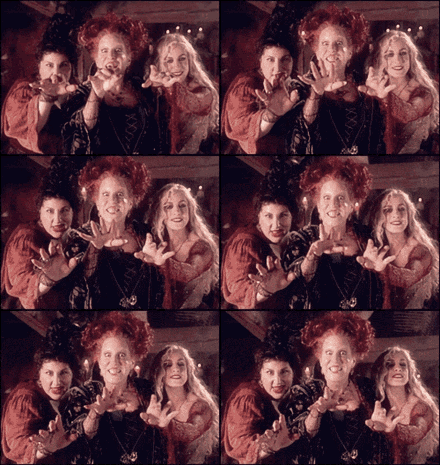
"It was the 80s, man!  I told you, the 80s was a wild place."

Personally, I love the theme of witchcraft.  When I say witchcraft, I'm not referring to the dark arts or sinister practices, rather to the idea of women asserting power when and where they can.  Imagine growing up in a world where you had no voice, your only purpose was to make a good match (hoping he wasn't an asshole), serve your husband, procreate, and keep it tight.  Your entire existence was subservient, reading novels was frowned upon and led to mental distraction, your appearance indicated your level of sanity (looking disheveled being the equivalent of insanity), and you were so tightly buttoned up -both literally and figuratively- that any misspoken word could destroy your reputation.  All this while your bones are being contorted in tiny, pointed shoes and your lung capacity diminished in disfiguring corsets.  It's no wonder we all got the vapors!

But there is something about witchcraft that reasserts a level of power.  Think about the symbols of witchcraft:  an understanding of nature and herbs (in a cauldron?) to heal and soothe, a broom to maintain cleanliness of a space, a cat to chase the mice away (still thinking hygiene, not to mention companionship), a connection to other women and their shared wisdom.  That's witchcraft.

Ultimately, it is this sort of witchcraft that is wielded in this book.  Generations of women, passing down their compassion, wisdom, and understanding to their daughters, granddaughters, and beyond.  Isn't that a lovely thought?

But yeah.  Some spooky and gross shit happens too.

A Lullaby for Witches

I'm just going to include the description for this book from it's Amazon page because I could do no better:

"Two women. A history of witchcraft. And a deep-rooted female power that sings across the centuries.

Once there was a young woman from a well-to-do New England family who never quite fit with the drawing rooms and parlors of her kin.  Called instead to the tangled woods and wild cliffs surrounding her family’s estate, Margaret Harlowe grew both stranger and more beautiful as she cultivated her uncanny power. Soon, whispers of “witch” dogged her footsteps, and Margaret’s power began to wind itself with the tendrils of something darker.

One hundred and fifty years later, Augusta Podos takes a dream job at Harlowe House, the historic home of a wealthy New England family that has been turned into a small museum in Tynemouth, Massachusetts. When Augusta stumbles across an oblique reference to a daughter of the Harlowes who has nearly been expunged from the historical record, the mystery is too intriguing to ignore.

But as she digs deeper, something sinister unfurls from its sleep, a dark power that binds one woman to the other across lines of blood and time. If Augusta can’t resist its allure, everything she knows and loves—including her very life—could be lost forever."


Unlike the witches in The Witch of Willow Hall, we encounter a darker force in the sequel-ish novel A Lullaby for Witches (also by Hester Fox).  Of the books I've read by this author (to date), this one is my least favorite.  The concept was intriguing, but the characters were bleh.  Ultimately, the plot felt contrived and the conclusion was forced.  I did like the main characters' connections to the Montrose family from The Witch of Willow Hall, but it fell short in most every other way.  In fact, it was so unmemorable that I'm done talking about it.

The Widow of Pale Harbor

In yet another novel by Hester Fox, we encounter the idea of witchcraft, but in a non-magic sort of way.  None of the characters in this book possess any actual powers, although rumors swirl in accusation of such wickedness.  

Set in the sleepy, idyllic town of Pale Harbor, Maine, we meet the newly bereaved Gabriel Stone, a widower intent on honoring his late wife's wishes of spreading the transcendentalist movement.  While Gabriel doesn't particularly believe in transcendentalism himself, his wife was passionate about it and, feeling a sense of guilt at her death (childbirth), he feels compelled to do something for her.  It's weird and far-reaching, but people do weird things for grief, I guess.

Meanwhile, the spooky, witchy widow Sophronia Carver ("She has a tail!") is living alone up at Castle Carver (not a castle, just a bigass house) with only three discreet servants to help her.  The entire town suspects Sophronia of having killed her late husband, a well-respected businessman and magazine editor, whose cosmopolitan appeal charmed the residents of the small town.


Remember how I said Hester Fox had a formula?  It applies here, too.  But please also remember what I said about that:  "While her stories are not what I would consider particularly highbrow, nor do they stick with you after the final page, they are certainly entertaining. [...]  If you go into one of her novels with this mindset, you might find yourself swept up in a dark, broody past, typically set in mid-19th century New England" (source: me).

Just like the premise for the character of Gabriel Stone, the entirety of this book is far-reaching from a critical standpoint.  But, these unbelievable prompts are what propel the plot (alliteration!) and allow for readers to be entertained.

Finally, in a deviation from Hester Fox, I have one more book about witches.

The Girl and the Witch's Garden

This final book centering on witches is nothing like the previous three.  In fact, this is a children's novel by author Erin Bowman.


When young Piper Peavey's father is diagnosed with cancer, she is sent to live with her estranged  mother and distant grandmother at the mysterious Mallory Estate.  Upon arriving, Piper learns that her mother has taken in a number of other children -all with magical abilities- while neglecting her own daughter.  Frustrated at her mother's apparent enthusiasm for her foster kids, Piper becomes hurt, jealous, and determined to figure out what is behind the strange happenings at Mallory Estate.

I was honestly drawn to this book by the cover art.  Isn't it charming?!?!?!?!  I love the illustration (especially the cat) and thought that my own daughter might enjoy the book, so I checked it out from our local library.  At the end of the story, she and I agreed: although it wasn't a particularly memorable read, it was (like those of Hester Fox) entertaining for the duration.  It's about the ride, right?

Clearly drawing from more classic children's literature (think: Harry Potter, The Secret Garden, etc.), The Girl and the Witch's Garden is a charming read, even for adults.  Themes of loss, grief, friendship, belonging, and family are all included in this story of the main character and her discoveries.  (Of note:  There are some potential triggers in this book as well including, but not limited to abuse, neglect, loss of a parent.)


Four different books, mostly enjoyable, all featuring something pertaining to witches.  Happy reading and HAPPY HALLOWEEN!


September 16, 2024

Elements of Cadence, a two part series by Rebecca Ross

 You guys know me by now, I think.  You know that I like fairytales, multi-faceted characters, elements of mystery, and -yes, I must confess- a drop of romance.  

Several months ago, one of my students paid me a great compliment: she recommended a book to me.  Yes, I know, anyone can recommend a book BUT, she recommended a book to me because she knows what I like and made her suggestion based on that.  What better compliment than to show that you know a person well enough than to offer them an adventure that is likely to please?

This student suggested that I read A River Enchanted, by Rebecca Ross.  At the time, I was not aware that this was the first in a duology.  It appears that both books were published in 2022, so I imagine they could be read like one great big mega book.  I listened to A River Enchanted on the Libby app and, upon discovering that it was the first of two, I immediately reserved the sequel, A Fire Endless.  So, some time lapsed between the two, but not enough for me to forget important plot elements.


Set on the fictitious island of Cadence, one can easily imagine this place as a far northern, remote location of Scotland.  In fact, the reader is Scottish (or at least reads with a Scottish accent, even during the book's credits), "the mainland" is often referenced, and the characters' plaids and kilts are frequently described.  "The Folk" (fairies/spirits) play huge roles throughout both of these novels, so they are -at the very least- inspired by Celtic legends and folktales.  And I love that.

We begin the story with Jack, a fatherless child of Cadence, whose mother had sent him to the mainland ten years prior to go to school and learn to become a bard.  In this time and place, a bard is a very prestigious position, reserved only for those who are very gifted in the art of song and storytelling.  Jack is summoned back home to Cadence -much to his chagrin- when he is around 20 years old.  Upon his return, we meet his family and the three other characters who will serve as the main ensemble for the rest of the duology: Adaira (heiress to the Tamarlaine clan lairdship), Torin (head guardsman, cousin of Adaira), and Sidra (talented healer, wife of Torin).  These four characters -Jack, Adaira, Torin, and Sidra- will continue to drive the plot for both books.  (Of no particular note: Sidra is my personal favorite.)

We also learn that the Isle of Cadence is split between two warring clans: the Tamarlaines in the East (clan to which our four protagonists belong) and the Breccans in the West.  The East has been blessed with bounty, light, and music, but they are often invaded by the West for their crops, livestock, and goods.  The West is a cold, desolate place where the people are hardened and desperate enough to invade the enemy territory in the East.  Still, the West has been gifted access to certain types of magic with little cost, rendering them all the more lethal to the East.

When Jack is summoned back to the East from the mainland, he soon learns the reason why.  Young Tamarlaine girls have begun disappearing and the heiress Adaira believes the spirits of the isle are behind it.  If nothing else, they might know why and where the girls are being taken.  But, in order to summon the spirits, a bard is required.  As the Tamarlaine clan has not had a bard since the death of Adaira's mother, the heiress is compelled to ask Jack to come back and sing for the spirits so that she can ask them for wisdom regarding the disappearance of the girls.  Reluctantly, Jack agrees to help.

Mysteries are solved.  Dark secrets are revealed.  Adventures are had.  It's a great fantasy read that incorporates so many of the things that I love about a good book and, as such, I would highly recommend the Elements of Cadence duology to anyone who is looking for a good escape.


August 9, 2024

Guys, I have a problem: more (murder) mysteries in a 3-for-1 post

I said it in the title and I'll say it again:  Guys, I have a problem.  I can't stop reading murder mysteries set in Great Britain.

These novels are all so contrived.  Most often, I guess the ending (at least in some capacity) before arriving at it, but I just enjoy the ride.  The character development is, if not profound, kind of fun; I like a puzzle and I like suspense.  But why are they always British?  I like tea and rain, but their food sucks and the period piece social hierarchies annoy the hell out of me.  I spent the entirety of the latest Downton Abbey movie hoping that we'd see the 1929 stock market crash so that I could watch the entitled Crawleys struggle to work and live like the rest of us.  (What can I say?  As an American, I'm born and bred to be informal and egalitarian.  I HAVE NO 'BETTERS'.)  So why do I keep gravitating to this very specific genre?

Today, I figured it out.

I'm not unique in my love of mystery novels.  There's a reason the genre is so prolific: people love it.  I'm also not unique in my interest in history and proclivity for historical fiction.  This Brit Lit often combines the two: mystery and history.  But, above all, the British mysteries towards which I gravitate are not violent.  Yes, there is violence in them (they are murder mysteries, after all), but it is never so graphic as to be difficult or gratuitous.  None of the authors whose works I've been reading go into gory details.  To add, animals rarely (if ever?) get hurt, which is a feature that I cannot/do not abide.  These are books that are easy to get lost in.  They are suspenseful without being scary.  They are safe (for the reader...not for the characters!), fun, and lend a sense of excitement to an otherwise mundane or routine day/week/month/whatever.

This past year, I have read a lot of mystery novels that I have reviewed here.  And, shameful though it may be, I don't intend to stop.  It's not the worst vice I have.  So, without further ado, here are the three most recent titles I have enjoyed:

The Hummingbird Dagger, by Cindy Anstey

In 1833, a young woman is found unconscious after a carriage accident outside a small village.  When she awakens, she has no memory of who she is or how she arrived at Hardwick Manor with the Ellerby family, where she now finds herself.  As she recovers, she tries to piece together her mysterious past and how it pertains to some of the strange happenings she and her new friends observe about the village.


As a Young Adult novel (I don't judge), The Hummingbird Dagger keeps a steady pace.  The characters may be flat and predictable, but that is precisely what keeps things moving in books like these.  It doesn't drag or spend too much time pontificating on useless details.  Easy to read and hard to put down, I'd recommend it as a "hot dog" book.

Miss Morton and the Spirits of the Underworld, by Catherine Lloyd

Last summer, while on vacation, I read the book Miss Morton and the English House Party Murder by Catherine Lloyd.  This summer, I picked up the second book in this series (by one of my favorite hot dog writers!) and enjoyed the hell out of it.  Much like every other book of this genre, Miss Morton and the Spirits of the Underworld is full of smoke and mirrors...and tropes.


Miss Caroline Morton is a fallen-from-grace blue blood, because her father made some bad decisions before croaking.  The former Lady Caroline has transformed into plain ol' Miss Morton, companion to the rich-by-honest-means (read: made money because of working) Mrs. Frogerton.  Bonus: former Lady Caroline/Miss Morton is also able to advise Mrs. Frogerton's daughter Dorothy on the upper crust meat marriage market.  But don't worry, Miss Morton isn't old and washed up yet.  This ol' bird's still in her twenties and keepin' it tight.

When Mrs. Frogerton drags Miss Morton to a seance, they have a terrific -albeit weird- time.  It's basically the equivalent to today's haunted house scene, but less bloody and more ghosty.  Apparently, in Regency England, people were very easy to dupe because they didn't have internet.  But when the spiritualist, Madam Lavinia, turns up dead, things get weird and it's up to our protagonists to solve the case...much to the dismay of the real police.

Just like its predecessor, Spirits of the Underworld is a fun, easy ride.  At barely 300 pages, it's a relaxing read that doesn't demand much from the reader at all.  And great news to me (although probably not to Miss Morton), there is another murder mystery that will rock her world later this month when Miss Morton and the Deadly Inheritance hits shelves on August 20!

The Last Heir to Blackwood Library, by Hester Fox

This last one isn't quite a murder mystery.  In fact, there is no murder -mysterious or otherwise- to solve!  Set in England just after the first World War, young Ivy Radcliffe suddenly inherits Blackwood Abbey in the Yorkshire moors.  Apart from her best friend and roommate, Ivy is alone in the world after losing her entire family to war and illness.  She is struggling to make ends meet in London and, upon the death of a distant and unknown relative, she is now proprietor of a great estate up north.  But when Ivy arrives at Blackwood Abbey, things become worrisome: gaps begin to appear in her memory, strange things happen in town, and rumors run rampant.  The staff are cold and distant.  Even the abbey itself seems to be haunted, leaving Ivy with no one and nowhere to turn for relief.  It is only when Ivy discovers the abbey's secret and mysterious library that she begins to make a home for herself...but things are never as simple as they seem.


A slight deviation from the classic murder mystery genre, I lumped this one in because it embodies the same sort of mysterious spirit that draws me to these books.  Written by New England author Hester Fox, The Last Heir to Blackwood Library has a flavor to it that reminds me a great deal of Rebecca, by Daphne du Maurier.  Both are Gothic novels featuring a young, naive heroine who must find her place in newfound status; both have dark undertones coming from the environs, atmosphere, staff, and the physical house itself that they are now tasked with running.  It's weird.  It's different.  I liked it.


I will try to branch out some more with a few non-mystery novels.  I have several other genres in my present line-up, many that I've already read and are just awaiting written reviews!  But I never make promises unless I know that I can keep them. ;)

July 22, 2024

The Marble Faun, by Nathaniel Hawthorne

 I did it.  I finally finished The Marble Faun.  And it took a looooooong time.  

It wasn't that it was particularly difficult reading, but I'd just lose interest, start and finish another book, then remember Oh yeah.  I was reading this, too.  I've read Hawthorne before but, honestly, not a lot.  I didn't remember him droning so much in his writing and I suppose, if I'd been his contemporary, I probably wouldn't have found the reading so slow.  If I'm living in the mid-19th century, it isn't like there is a lot to do for recreation beyond chasing a hoop with a stick, right?


But The Marble Faun isn't the type of book that you just read on a lark.  It's deep, yet shallow; profound, but contrived; gothic, but still moralizing.  The story follows four friends living in Rome.  Three of them are American expats, living and working as artists (Miriam, Hilda, Kenyon); one of them is a count from the Italian countryside (Donatello).  We begin the story with the three American artists belittling their "simple" Italian friend (he is not simple, they are just racist) and comparing him to the Marble Faun of Praxiteles.


Fortunately, they keep all comparisons above the waist, focusing solely on his face and expressions.  Apparently, the "simplicity" of his race renders Donatello -like this marble faun- happy and incapable of comprehending melancholy, anger, sadness, or any of the darker emotions.  No, Donatello the marble faun can only understand levity and joy, like his kind, the woodland sprites and wild, savage creatures of nature.  Hell, he probably even has pointy ears under his mess of uncut hair!  WHAT A GROSS EUROPEAN!

In spite of their jovial mockery, the foursome are inseparable.  Kenyon is deeply in love with Hilda (praised for her severe purity); Hilda is BFFs with Miriam; Donatello is smitten with Miriam and follows her like a dog (Hawthorne's description, not mine); and they are all pals 4eva!  Until one day when a spooky dark stranger follows Miriam around on a group tour of the catacombs.  

But who is this dark stranger who follows her around like a creeper for the remainder of the book?  He is clearly distressing her but, weirdly, none of her friends offer to help a girl out...except for poor, besotted Donatello, who apparently can feel ire when it comes to weirdos stalking his girl.  But Miriam is guarding a dark secret, so she refuses his offers to destroy the president of her fan club.

Still.  He just wants her to know that he's ready.  She just has to say the word.


One night, a horrible crime takes place, and scatters the friends in different directions.  Hilda's judgmental piety prevents her from being a good friend; Donatello apparently can feel emotions, like a real boy; Miriam insists on punishing herself because she rebuffed a stalker; and poor Kenyon remains clueless.  Meanwhile, Hawthorne drones for days between the action about how Rome is both gross (there are bugs and poor people) and beautiful (there is art and stuff).

So why did I want to read this book?  Well, two reasons:

  1. The jacket description sounded more intriguing than it actually was.
  2. This lady:


One of my favorite movies of all time is Grey Gardens, the documentary of Edith Bouvier Beale and her daughter, also Edith Bouvier Beale (Big Edie, Little Edie).  These ladies were relatives of Jackie Bouvier Kennedy Onassis and lived in squalor in their home estate in the Hamptons.  Well-educated and well-read, Little Edie (pictured) mentions how their errand boy Jerry reminds her of the Marble Faun.  She asks him if he's read the book (he hasn't) and explains that she wonders if he "would be up for it" (as in, "would comprehend it because he is as 'simple' as Donatello").  Of course, her thick NY accent makes her say The Mawble Fo-awwwwn so, obviously, I had to read it.


And I did.

June 15, 2024

Morse's Greatest Mystery and Other Stories, by Colin Dexter

 Remember how much I love British murder mysteries?  I really don't know what it is.  They just remind me of the game of Clue, and how much fun I had playing that as a kid.  I used to take the weapons from the board game and use them with my Barbies, creating Malibu murder mysteries.

It was SKIPPER in the DREAM HOUSE SALON with the CANDLESTICK!!!!

Anyway...

About six or seven years ago, I was really into the series Father Brown.  I enjoyed the 1950s English vicar solving mysteries with his little team of rag tag villagers.  Once the series got pulled from Netflix, a friend of mine with a similar bent for the preposterously posh introduced me to the Masterpiece series, Endeavour.  Older episodes were available on Prime at that point, with new ones being released on PBS.  She and I watched this show religiously for the next several years, until the series finale last summer.

For those of you who are familiar with Endeavour, you are aware that it is a precursor to the equally British series Inspector Morse of the 1980s-1990s.  Both shows follow the character Endeavour Morse throughout various points in his career (Detective Constable, Detective Sergeant, Detective Inspector...).  Endeavour begins in 1965 with a 20-something Morse as a Detective Constable in Oxford.  Not your typical policeman, Morse is something of a brain, having been an Oxford student during his troubled past.  Amazing at solving puzzles and riddles, Morse also favors the classics and is a big opera nut.  To balance this out, he is also an on-and-off heavy drinker, has a passion for fast cars (eventually leading to his trademark Jaguar), and self-destructive behaviors.  As a prequel, Endeavour endeavors (see what I did there?) to set the backstory for the Inspector Morse known to fans of the show that peaked in the 90s.

Endeavour Morse and Inspector Fred Thursday, Endeavour (2012-2023)
Setting: Oxford England, 1960s-1970s

Endeavour Morse, Inspector Morse (1987-2000)
Setting: Oxford England, contemporary (1980s-1990s)


But we are getting ahead of ourselves!  BOTH of these successful television shows are based on characters created by mystery writer Colin Dexter.  In fact, Mr. Dexter was instrumental in the creation of Endeavour as a show, even making a cameo appearance in an early episode.  (I am uncertain as to his involvement in the Inspector Morse series, but I imagine he had a hand.)  His contributions to Endeavour undoubtedly lent authenticity and continuity to the titular character and, as any fan loyal to a longstanding show coming to an end can understand, I wanted more of these characters I'd grown to love.

What better way to do that than to go straight to the source?!  This seemed like a good place to start:


This collection of short stories by Colin Dexter was available on Libby.  It did take me some time to adapt to Frederick Davidson's readings of the stories, as I found him moderately difficult to understand without concerted effort and concentration.  Once I made that aural adjustment, I was able to follow with ease.

I was surprised, however, at how many stories did not feature Morse or his cast of Oxford colleagues.  There were several non-Morse stories, including even a Sherlock Holmes piece.  I was confused by this, given the title of the book, and eventually just had to accept it as a collection of mysteries by Colin Dexter...with some Morse involvement.

Of those stories that did include Morse (just a few), I was surprised to find him featured as more of a background character:  the older Inspector Morse, not the younger DC/DS Morse that I had come to know over the years.  The stories in which he did appear -still his lovably bitter, prickly self- usually centered around his subordinates and co-workers, which I found disappointing.  I checked this book out, after all, because of Morse!

To be honest, I found this book mostly forgettable.  I read it a couple of months ago and am just now getting around to the review.  (The kids are out of school and, while I'm still doing a lot of reading, I'm not getting to much writing time.)  I'm struggling to remember many details about it, but I do recall feeling rather "meh" about the collection of stories.  They made for good, diverting entertainment, but not something that will stay with me for years to come like the TV show.

Morse ultimately meets with a terribly tragic end.  In fact, his entire life is one self-inflicted tragedy after another.  Yet you can't help but like the guy.  Sure, he's growly and condescending, but he has a good heart.  Even though I didn't necessarily love this collection of stories by Colin Dexter, I do love the characters that he created.  For this reason, I will probably pick up another Morse book in the future.


May 1, 2024

Cheesy, Cheeky, Old-Timey, British Murder Mysteries: A Two-For-One Post!

It has been a whirlwind of activity around here and, despite continuing to read/listen to books, I am just now getting caught up on writing reviews.  You see, I had foot surgery yesterday afternoon and am presently stuck in a chair under the influence of Rx narcotics.  Might as well write the most riveting review in the history of the sport.

Sadly, riveting is not the word I would use to describe either of the following novels.  I got on a British murder mystery kick as I tend to when in between other genres.  I like the ease of them and, most particularly, trying to peg the murderer(s) before the author reveals them.  Add in some preposterous Regency backdrop and sensibilities (be they Georgian, Victorian, Edwardian, Amphibian) and it's a recipe that generally entertains me.

But these last two?  Cringe!

The first (and perhaps the worse)  of the two was Lady Helena Investigates, by Jane Steen.  To be fair, I listened to this one in audio format and absolutely HATED the narrator.  Had I read it in print, perhaps I would have felt differently...but only slightly.


I generally don't like to rip people's work apart, but when I find myself hoping the protagonist gets murdered -or at the very least clotheslined- I struggle to silence the beast.  


The youngest child of the noble Scott-De Quincy family, Lady Helena Whitcombe is suddenly widowed in her twenties.  Her overbearing (though mostly well-meaning) family seeks to absorb her late husband's fortune and marry her off to someone else as soon as the required mourning period is up.  But when The Trifecta -the village's new doctor, who also happens to be handsome and French- suggests that Sir Justin (I'm sorry, Sir Justin?  Is he a country gentleman or a Delta Tau Chi pledge?) did not die by accidental drowning, then Lady Helena must indeed investigate her beloved husband's murder...with the help of le bon docteur.

The first novel of the Scott-De Quincy Mystery series (good God, there are more of them?) was entirely predictable.  I'd been wanting a hot dog book -the type of book that might taste good, but isn't necessarily good for you; a "sometimes book"- and this one was Vienna sausage. 🤮 Lady Helena's dog was the only redeeming thing about her privileged, entitled life, but she even ruined that by naming him "Scotty".  Oh how original from someone whose maiden name is Scott-De Quincy.  What a twat.

Alas, even after this turd of a book, I still have not given up on my beloved hot dogs.  So I ate another one:  Snobbery with Violence, by M.C. Beaton (a.k.a. Marion Chesney).


Marginally better, I still found this book mostly forgettable.  Honestly, I finished it just over a month ago and I'm having to read the cover summary to remind myself what I read.  

Oh yeah!  This was the one with the predictably rebellious only child (a daughter) of an earl and lady-earl (whatever that's called -- England is weird, man!).  Lady Rose Summer is supposed to get married, but discovers her intended is a dick and calls it off.  Her parents are so desperate to avoid the embarrassment of a daughter who isn't married by the time she is 20 (or something) and they want to cover up the scandal of her appearing in the newspapers with suffragettes.  So they do the only thing loving parents can do: they send her to the home of noble friends who are hosting a meat market for marriageable young ladies and gentlemen to hook up in their gross old castle.  Then murders happen and it's like Clue at Downton Abbey.  SPOILER:  Lady Rose even gets pushed off a building (!) but she survives by landing in the castle's moat.

Of course, in order to flesh out the character of Lady Rose, she has to have a pet.  In this version of the same story as all of these stories, her pet is a human named Daisy.  (Rose and Daisy.  Lesser flower = lesser person, I guess.)  Daisy is a Cockney actress whom Lady Rose teaches to read, then subsequently hires as her lady's maid, leading Daisy to be so hopelessly devoted that she resembles a cocker spaniel more than a loyal friend.  But let's face it: even in stories and fairy tales, the rich and beautiful always need someone less rich and less beautiful to live for nothing but doing their hair and bringing them hot cocoa before bed...even when they're grownass adults.

Indeed what would a story like this be without some sort of reluctant romance?  Enter salty, old-but-still-in-his-twenties Captain Harry Cathcart, the impoverished younger son of a baron, who has recently begun working in private intelligence for hire.  He finds Rose annoying and unfeminine, but by jove is she beautiful, and therefore, irresistible.  

Perhaps the thing that most makes Snobbery with Violence superior to Lady Helena Investigates is a single line from the book.  This was a line that called my emotional maturity into question in a way that I'm not embarrassed to admit, but before I share it...

Lady Rose is on the precipice of a fashion revolution to reflect the growing support for women's rights in the western hemisphere.  Suffragettes demanding equality and the right to vote is synonymous with women ditching their corsets and other restrictive accessories.  (Thank God!  Can you imagine still wearing all of those buttons?  Distorting our spines and ribs?  Crushing our organs?)  Anyway, quick history lesson:  Do you know how corsets are made and how they work?  The short version is that rigid strips are placed vertically to help comprise the frame of a corset.  While types of corsets and materials used changed throughout history, these vertical strips are called boning.  This is likely due to the fact that, in early corsets, they used actual whalebone to create these devices.

Snobbery is set during the Edwardian Era, like this corset
(roughly 1901-1919)


Early 20th Century Style Corset

I may have ruined the punchline with all this lead up, BUT, it is important that understand boning to appreciate my favorite line from Snobbery with Violence.  Having a conversation with her mother about her wardrobe choices, Lady Rose attempts to explain why she has chosen to wear a blouse and skirt instead of a corset and gown/dress.  The response from the elder Lady-Earl Summers is without equal:

A lady must ohhhhhhhhlways* be prrrrrrrrroperly** boned***.


*British for "always"
**Really roll those RRRs for the most uppity effect
***Pronounced boooowwwwwned, in the most Jiminy Glick way possible


And with that, I take my leave.

March 19, 2024

Hester, by Laurie Lico Albanese

Since I started listening to a lot more books in audio format, I've been able to actually start chipping away at my long list of books to read.  One book that happened upon my list (I forget where I heard of it) was Hester, by Laurie Lico Albanese. 


After reading my previous book, I wanted something lighter.  I did not find it.  

OK, I take that back.  Hester is lighter in the sense that it is a novel that will sweep you into another world, but it isn't lighter in terms of subject matter...something I ought to have known based on the premise!

The story is a complete fictionalization of the woman who would come to influence Hester Prynne of Nathaniel Hawthorne's The Scarlet Letter.  In her novel, author Laurie Lico Albanese imagines Isobel Gamble, a young newlywed Scottish immigrant who crosses the Atlantic with her husband, Edward, to begin a new life in Salem, Massachusetts.  Edward leaves her almost immediately to go back to sea as the ship's doctor/apothecary.  As Isobel remains alone in Salem, she meets a young Nathaniel Hawthorne, becoming his muse.

As she comes to learn, Nathaniel's history is one of guilt and shame that did indeed burden the writer in reality.  [Fact: The staunchly Puritan Hathorne family was instrumental in the convictions at the Salem witch trials of the 1600s.  Nathaniel Hawthorne was so ashamed of this history within his own family, that he even added the "w" to his name in an effort to distance himself from that dark aspect of his past.]  Yet Isobel has family secrets of her own.  Centuries past, her own "ancestress" was an accused and convicted witch who, with the help of friends (and perhaps the fairies of the Scottish highlands), was able to escape her own execution.

The premise of the book is certainly intriguing, particularly for those who have read The Scarlet Letter and will recognize the parallels.  While addressing the topics of witches, insanity, and moral ethics, the story also features a great deal of synesthesia and its role in individuals who did not understand it as a pathology/condition/gift (however you wish to define it).  I was surprised at the liberties taken by the author when it came to the character of Hawthorne, and wonder how he might take her rendition of him.  It's probably a good thing he's dead and not around to read it.


Once I realized the direction that the book was going with Hawthorne's character, the story became somewhat contrived and predictable.  While he was certainly no angel in real life, I felt it a somewhat unfair portrayal of him...unless she knows something I don't, perhaps?

Regardless, Hester is not a particularly cerebral book.  It has equal measures of intrigue, mystery, history, and romance, and makes for a good escape from the mundane.  Enjoyable, though perhaps not for everyone.